
Why Is SEO Important for Ecommerce? Because shoppers are already searching for the products you sell. A strong ecommerce SEO strategy helps your store appear at the right moment, attracting high-intent traffic, building trust, and reducing reliance on paid ads.
If you run an ecommerce store, you already know there are a lot of ways to get traffic.
You can run ads.
You can post on social.
You can work with influencers.
You can send emails.
You can pour money into promotions and hope the numbers work out.
But here’s the question too many brands avoid:
What happens when you stop paying for attention?
That’s where SEO starts to matter a whole lot more.
Because ecommerce SEO is not just about “getting found on Google.” It’s about helping the right people find your products, your category pages, and your brand when they’re already looking for what you sell. It’s about building a stronger acquisition channel, reducing overreliance on paid traffic, and creating a more sustainable path to growth.
And in 2026, with rising ad costs, AI Overviews, and more competition in nearly every category, that matters even more.
Table of Contents
What Ecommerce SEO Actually Does
At the simplest level, ecommerce SEO helps your online store show up in search results when shoppers are researching, comparing, and buying.
That includes:
- category pages
- product pages
- buying guides
- comparison content
- supporting blog content
- even image and rich search results in some cases
So no, SEO is not just “adding keywords.”
It is the work of making your store easier to find, easier to understand, easier to crawl, and easier to trust.
And for ecommerce brands, that can directly affect traffic, conversion rate, customer acquisition cost, and long-term revenue.
Why is SEO Important for Ecommerce?
1. SEO Helps You Capture High-Intent Traffic
Not all traffic is equal. You know that. I know that. Yet a lot of businesses still chase volume like volume alone means growth.
It doesn’t.
A person casually scrolling Instagram may become a customer someday.
A person searching “best waterproof motorcycle gloves for winter riding” is in a very different place.
They are looking.
They have context.
They have intent.
And in many cases, they are much closer to buying.
That is one of the biggest reasons SEO is important for ecommerce.
It helps you show up when shoppers are already searching with purpose.
That search might be broad, like:
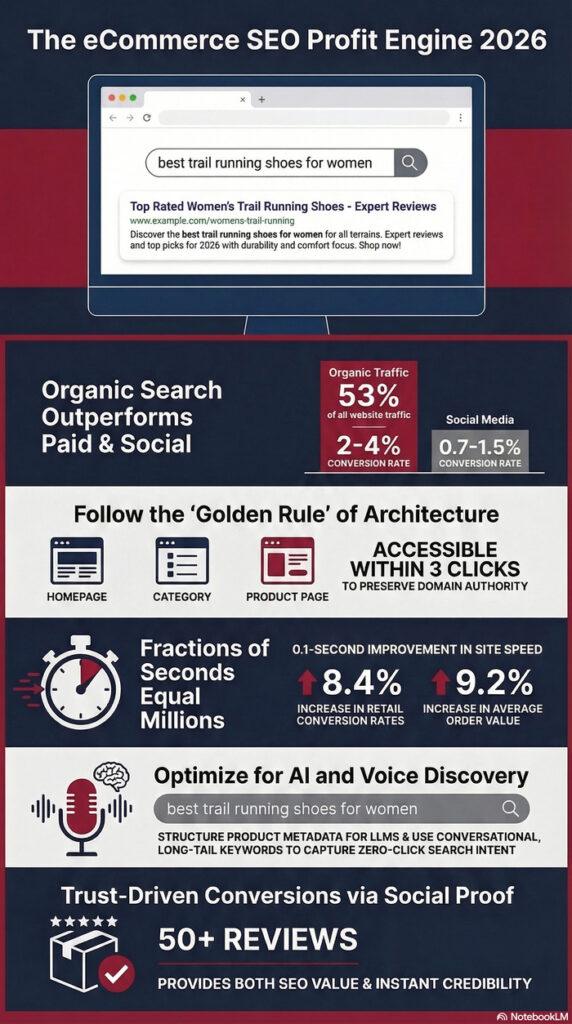
- best trail running shoes for women
Or more specific, like:
- women’s waterproof trail running shoes size 8
Or comparison-driven, like:
- brooks ghost vs glycerin for walking
Or ready-to-buy, like:
- buy matte black jeep wrangler lift kit
Those are not random visits. Those are opportunities.
And the more your site is optimized around the way real people search, the better your chances of attracting traffic that is actually worth something.
2. SEO Is One of the Best Ways to Reduce Overreliance on Paid Ads
Let’s say the quiet part out loud.
A lot of ecommerce brands are too dependent on paid traffic.
Paid ads can absolutely work. I am not anti-ads. Paid can be great for product launches, promotions, testing, and fast visibility.
But paid traffic is rented traffic.
The second you turn off the budget, the visibility disappears.
SEO works differently.
Done well, SEO builds value over time. Your category pages can keep ranking. Your product pages can keep earning clicks. Your educational content can keep bringing in new shoppers long after it is published.
That is why I tend to think of PPC as renting and SEO as building equity.
One gives you immediate access.
The other helps you build an asset.
And if your store is in a competitive space, that matters. Because rising acquisition costs have a way of exposing weak foundations.
If every sale depends on ad spend, what happens when costs go up?
What happens when performance dips?
What happens when your margin gets squeezed?
That is where organic visibility starts looking a lot less like a “nice to have” and a lot more like protection.
3. SEO Supports Ecommerce Growth Across the Whole Buying Journey
Another mistake I see? People treat ecommerce SEO like it only matters for product pages.
It doesn’t.
Yes, product and category pages matter a lot. But shoppers do not always enter your world at the purchase stage.
Sometimes they are still figuring out what they need.
Sometimes they are comparing options.
Sometimes they are trying to solve a problem before they are ready to buy.
That means strong ecommerce SEO usually supports multiple stages of the journey:
Discovery
This is where people search things like:
- how to choose the right torque wrench
- best protein powder for sensitive stomachs
- what size dog crate should I get
Evaluation
Now they are narrowing options:
- best torque wrench for home mechanics
- whey isolate vs concentrate for beginners
- medium vs intermediate dog crate size
Purchase
Now they are looking for a solution:
- 1/2 inch drive click torque wrench
- lactose-free vanilla whey isolate
- 36 inch heavy duty dog crate
A strong ecommerce SEO strategy helps you meet people across that path.
And when you create the right mix of commercial pages and helpful content, you are not just chasing rankings. You are building a search presence that supports the way people actually shop.
4. SEO Builds Trust Before the Click
People are skeptical. And honestly, they should be.
Shoppers know they are being marketed to from every direction. They are hit with ads on social, email promotions, retargeting, sponsored placements, influencer recommendations, and AI-generated fluff that all sounds suspiciously similar.
So what makes someone trust your brand enough to click?
Visibility helps. But so does how you show up.
When your site appears organically for relevant searches, especially for high-intent searches, it signals something important: your store is relevant enough to earn that spot.
That does not mean shoppers blindly trust every ranking page. But organic visibility still carries credibility in a way that paid placements often do not.
And if your search result includes strong titles, clear descriptions, product details, reviews, or other enhancements, that trust signal gets even stronger.
Ask yourself this:
If someone searches for the kind of products you sell, does your store look like the obvious next click?
If not, SEO is not just a traffic problem. It is a trust problem too.
5. Better Ecommerce SEO Usually Means Better User Experience
This is one of the reasons I get annoyed when people talk about SEO like it lives in a silo.
Good SEO and good user experience are not enemies. For ecommerce, they are deeply connected.
Think about what helps an online store perform better organically:
- fast-loading pages
- clean site structure
- easy navigation
- mobile usability
- strong internal linking
- useful product descriptions
- optimized images
- structured data
- clear category organization
Now think about what helps actual humans buy.
Pretty much the same list.
If your site is slow, confusing, bloated, hard to navigate, or full of thin product pages, that hurts both SEO and conversion performance.
That is why ecommerce SEO is not just about rankings. It is also about making the store easier to use. If you need a practical place to start, this ecommerce SEO checklist can help you spot some of the issues that quietly hurt both visibility and sales.
And in ecommerce, small improvements can matter a lot. A slight speed improvement or cleaner page structure can affect bounce rate, engagement, conversion rate, and average order value.
So when someone says SEO is only about keywords, that is usually a sign they do not understand ecommerce SEO very well.
6. SEO Helps Smaller Brands Compete More Strategically
No, SEO does not magically erase the fact that Amazon exists.
No, it does not mean your smaller brand will outrank giant retailers for every broad head term.
But that is also not the point.
SEO gives smaller and niche ecommerce brands a chance to compete strategically.
That often looks like:
- targeting more specific long-tail searches
- creating stronger category pages
- building content around use cases and buyer questions
- showing up for comparison searches
- owning niche product terms
- building authority in a focused corner of the market
This matters because not every shopper is searching for the broadest term possible.
Many people are searching with specific needs, specific problems, and specific modifiers.
That is where smart ecommerce SEO can create real opportunities.
Instead of trying to beat bigger players at everything, you create visibility where your brand has a legitimate shot to win.
And for niche ecommerce brands especially, that can be a much smarter path than trying to outspend everyone on ads.
7. SEO Can Improve Margins Over Time
This is one of the biggest business reasons ecommerce brands should care about SEO, and oddly enough, it does not get talked about enough.
Traffic is nice. Revenue is important. But profitability matters too.
If your customer acquisition strategy is heavily dependent on paid channels, discounts, and constant promotions, your margins are always under pressure.
Organic search can help balance that.
Not overnight. Not magically. Not without work.
But over time, strong SEO can help you:
- lower dependence on paid acquisition
- drive more non-branded traffic
- improve traffic quality
- support repeatable discovery
- build content that continues working after publish day
That compounding effect is one of the biggest reasons SEO is so valuable for ecommerce.
You are not paying for each click forever. You are building a stronger system for earning visibility.
And when you pair that with a better customer experience, better product pages, and stronger conversion paths, SEO becomes more than a traffic channel. It becomes part of your growth engine.
8. Product Pages and Category Pages Need SEO Too
A lot of ecommerce sites either over-focus on blogging or skip content entirely and hope product pages do all the heavy lifting.
Usually, the right answer is somewhere in the middle.
Your blog can help capture informational and comparison intent. But your commercial pages still need serious attention.
That includes:
Category pages
These often deserve some of the biggest SEO focus because they can target broader commercial intent and help shoppers move deeper into the store.
Product pages
These matter for bottom-funnel searches, long-tail searches, branded product demand, and rich result opportunities.
Supporting content
Guides, FAQs, comparisons, and educational content can attract early-stage searchers and help support internal linking to commercial pages.
If your ecommerce SEO strategy is all blog and no commercial intent, that is a problem.
If it is all products and no supporting content, that can be a problem too.
You want a structure that supports discovery and conversion. And if you want a bigger-picture view of what that looks like, these ecommerce SEO best practices will help you connect rankings to revenue instead of treating SEO like a disconnected checklist.
9. Technical SEO Matters More for Ecommerce Than Many Brands Realize
Here is where things can get messy fast.
Ecommerce sites often have more moving parts than standard business websites:
- hundreds or thousands of product URLs
- category and subcategory layers
- filters and faceted navigation
- product variants
- pagination
- duplicate or thin content risks
- out-of-stock product handling
- crawl efficiency issues
This is one reason ecommerce SEO is not just “regular SEO, but more products.”
Technical structure matters.
If your site architecture is bloated, if important pages are buried, if filters create a mess of unnecessary URLs, or if search engines are wasting time on low-value pages, that can drag down performance.
Ecommerce sites also struggle with faceted navigation SEO issues, where filters create thousands of low-value URLs that waste crawl budget and dilute ranking signals.
That does not mean every ecommerce brand needs a massive enterprise SEO operation.
It does mean that if your store has grown over time, technical SEO should not be an afterthought.
Because when search engines struggle to crawl, understand, and prioritize your most important pages, rankings are not the only thing that suffer. Revenue opportunities do too.
10. SEO Still Matters in the Age of AI Overviews and AI Search
This question is coming up more and more now, and fair enough.
If Google is giving answers directly in AI Overviews, and people are also using ChatGPT, Perplexity, and other tools, does SEO still matter?
Yes. Absolutely. But the way you think about it needs to mature.
Search is shifting. Some clicks are being absorbed. Informational intent is getting compressed in certain cases. People may get faster answers without visiting as many websites.
But ecommerce search has not disappeared.
People still need products.
They still compare options.
They still want reviews, specs, pricing, visuals, shipping info, and trust signals.
They still need a place to buy.
In fact, if anything, this shift makes strong SEO more important. Recent research shows that ChatGPT ecommerce traffic converts higher than traditional organic search, suggesting AI-driven discovery may send fewer visitors but higher-intent ones.
Because now your site needs to be:
- clear
- well-structured
- easy for search engines and AI systems to understand
- supported by strong content
- reinforced by brand mentions, reviews, and authority signals
Schema, content structure, product detail clarity, and trustworthy supporting content all matter here.
So no, SEO is not dead. But lazy SEO is not going to cut it.
SEO Is Not Fast, but It Is Worth It
If you want instant traffic, run ads.
If you want a stronger long-term acquisition channel, invest in SEO.
That does not mean SEO is quick. It is not. It takes strategy, execution, patience, and consistency. It also takes a site you can actually improve, which, frankly, not every ecommerce platform or setup makes easy.
But for brands that want more than temporary spikes, SEO is worth building.
Because the goal is not just more rankings.
It is not just more traffic.
It is not just more blog posts.
The goal is better visibility for the right searches, better discoverability for your products, lower dependence on rented traffic, and more opportunities to convert the people already looking for what you sell.
That is why SEO is important for ecommerce.
Not because it sounds smart.
Not because every agency says it is.
Because when it is done well, it helps the right shoppers find you, trust you, and buy from you.
And for an ecommerce brand trying to grow without setting money on fire every month, that matters.
Final Thought
If your ecommerce growth depends mostly on ads, promotions, or hoping social content takes off, it may be time to ask a harder question:
Are you building momentum, or are you just paying to stay visible?
That answer usually tells you exactly how important SEO is for your store.
FAQs About Why SEO is Important for Ecommerce Businesses
Is SEO worth it for ecommerce?
Yes. SEO helps ecommerce brands attract high-intent traffic, reduce reliance on paid ads, and build long-term visibility in search engines.
How long does ecommerce SEO take to work?
Most ecommerce SEO strategies take 3–6 months to begin showing measurable traction, depending on competition, site authority, and technical health.

J. “Ivy” Boyter is the founder of Full Throttle SEO, a Florida-based SEO consultancy. With nearly 15 years of digital marketing experience, she helps businesses turn search visibility into qualified leads and revenue, with a focus on ecommerce SEO, technical audits, and visibility in AI-powered search. Her approach connects SEO priorities to business goals, helping brands show up, get chosen, and deliver results.
Outside of work, Ivy competes in autocross and rallycross, wrangles kids and chickens, and writes heartfelt marriage and parenting advice.