
If you’re spending five figures a month on ads but your organic revenue is flat, this guide is for you.
Because here’s the uncomfortable truth:
Most ecommerce brands don’t have an SEO problem. They have a foundation problem.
They’re pouring paid traffic into:
- Thin category pages
- Bloated faceted navigation
- Slow mobile performance
- Duplicate product content
- Broken internal linking
And then blaming “the algorithm.”
Ecommerce SEO in 2026 is no longer about keywords and hope.
It’s about:
- Technical precision
- Structured clarity
- Authority concentration
- Revenue prioritization
SEO is still important for your Ecommerce site and this is your complete guide to ecommerce SEO best practices.
The Shift: Why Ecommerce SEO in 2026 Is Different
- AI Overviews summarize informational content.
- Click distribution is compressed into the top three.
- Google cross-validates product feeds with on-page data.
- Thin content is filtered out faster than ever.
If your SEO strategy still looks like:
“Optimize some product pages and build a few backlinks”
You’re playing 2018 games in 2026.
Let’s fix that.
Foundation First: Technical Ecommerce SEO (Non-Negotiable)
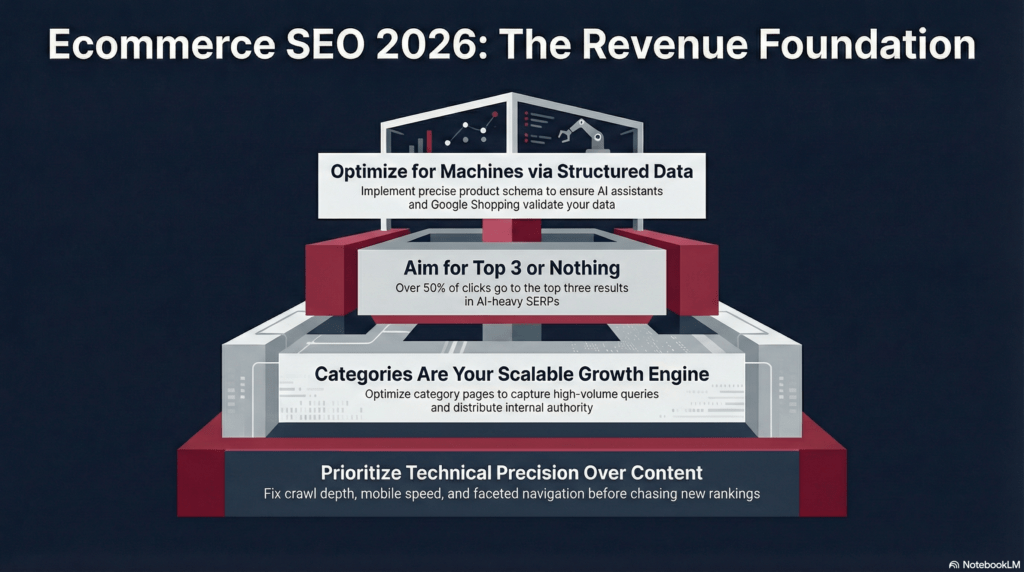
You cannot out-content a broken site. Before you chase rankings, fix architecture.
1. Site Architecture: Crawl Depth Matters
Every product should be reachable in three clicks or fewer.
Ideal structure:
Homepage
  → Category
      → Subcategory
          → Product
Avoid:
- Orphaned products
- JavaScript-dependent navigation
- Infinite URL parameters
- Crawl traps in filters
Google and AI tools do not reward chaos. They reward technical clarity in structure.
2. Faceted Navigation Control (The Silent Killer)
Color filters. Size filters. Price sorting.
Left unchecked, these generate thousands of low-value URLs.
Best practice:
- Canonical filtered pages to the parent category (unless the filter has real search demand).
- Noindex useless combinations.
- Only index filters with proven keyword volume.
Indexing everything is not aggressive. It’s dilution.
3. Mobile Speed Is Revenue
Over 75% of ecommerce traffic is mobile. If your LCP is over 2.5 seconds, you’re burning money.
Prioritize:
- Image compression
- CDN deployment
- Script reduction
- Lazy loading (done correctly)
- Minimized third-party apps
Core Web Vitals aren’t vanity metrics. They’re conversion insurance.
Category Pages: Your Real SEO Assets
Most brands obsess over product pages. And while they’re important, overlooking category pages is a mistake.
Category pages:
- Capture higher-volume queries
- Distribute authority internally
- Scale better
- Convert mid-funnel traffic
How to Structure an SEO-Optimized Category Page
Required elements:
- Clear H1 matching search intent
- 300–600 words of meaningful intro content
- Subcategory internal links
- FAQ section (schema-enabled)
- Links to top sellers
- Clean filter handling
Example structure:
H1: Waterproof Hiking Boots
Intro (value-focused, not fluff)
Product grid
Buying guide
FAQ
Category pages are your scalable growth engine.
Product Page Optimization: No More Thin Content
Manufacturer copy is not SEO. It’s duplication that Google simply doesn’t like.
Every high-performing product page should include:
- Unique description (benefit-focused)
- Specs table
- Internal cross-links
- Reviews
- FAQs
- Product schema
- Offer schema
- Review schema
Structured data is mandatory, not optional.
Reference:
Google’s ecommerce structured data guidelines
Keyword Strategy: Stop Guessing
There are three types of keywords you must target.
1. Transactional (“Money Terms”)

Examples:
- buy adjustable dumbbells
- organic dog food bulk
- ceramic nonstick cookware set
These map to:
- Category pages
- Core product pages
2. Commercial Investigation
Examples:
- best adjustable dumbbells
- top nonstick cookware brands
- adjustable dumbbells vs kettlebells
These map to:
- Comparison content
- Buying guides
- Collection pages
3. Informational Support

Examples:
- how to clean ceramic cookware
- how much protein does a dog need
These feed:
- Blog
- Help center
- Pre-purchase education
AI search filters informational traffic, but it amplifies authority. Don’t skip it.
Internal Linking: Your Authority Distribution System
Every category should link to:
- Best sellers
- Supporting guides
- Comparison content
Every product page should link to:
- Related products
- Parent category
- Relevant blog content
Anchor text should match intent naturally.
One or two contextual links per section is enough.
Internal linking is not decoration, it’s infrastructure that both traditional and AI searches are looking for.
Structured Data & Product Feeds: Optimize for Machines
AI assistants and Google Shopping depend on structured data (schema).
You must implement:
- Product schema
- Offer schema
- Review schema
- Breadcrumb schema
- FAQ schema
Then verify your feed in Google Merchant Center.
Make sure:
- Pricing matches on-page
- Availability matches
- Variant data is accurate
Google cross-checks feeds against structured data.
Mismatch = visibility suppression.
The Top 3 Rule: Page One Is No Longer Enough
Over 50% of clicks go to the top three results.
Positions 5–10? Still important but fewer people are likely to visit your website.
Better strategy:
Dominate three money terms in top three positions instead of ranking #7 for thirty.
Reallocate resources accordingly.
AI Search: Optimize for Assistants, Not Hacks
Nearly 60% of shoppers use AI assistants during buying decisions.
Optimization for AI is not magic, nor is it optional. It’s a requirement to not get left behind in AI searches.
Focus on:
- Structured FAQs
- Author credibility signals
- Comprehensive answers
- Clear specs and comparisons
- Consistent schema
Ignore AIO, AEO, and/or GEO gimmicks.
If Google can’t crawl you properly, no AI hack will save you.
On-Site Search: Your Free Keyword Research Tool
Most ecommerce brands ignore internal search data, and that’s a mistake.
Track:
- Most searched terms
- Zero-result searches
- High-frequency product queries
If users search for something repeatedly, build the landing page because your customers are telling you what they want.
Listen.
Reviews & UGC: Trust Is a Ranking Multiplier
High-performing product pages include:
- Real customer photos
- Video reviews
- Detailed feedback
- High review counts
Caraway does an excellent job of providing videos and UGC, which you can see here:

Search engines prioritize social proof which increases:
- Conversion rate
- Dwell time
- Authority signals
Measuring Ecommerce SEO the Right Way
Stop obsessing over sessions. AI Overviews reduce informational clicks.
Track instead:
- Organic revenue
- Revenue per landing page
- Assisted conversions
- Organic conversion rate
- Branded search growth
Lean traffic + higher revenue is a healthy funnel.
FAQs About Ecommerce SEO Best Practices
What’s the best SEO strategy for ecommerce websites?
A revenue-first strategy that prioritizes technical crawl health, category page optimization, structured data implementation, and top-three rankings for high-intent transactional keywords.
What is the 80/20 rule for SEO?
80% of ecommerce revenue typically comes from 20% of pages. Optimize your top-performing categories and products before expanding into new keyword targets.
What are the 3 C’s of SEO?
The 3 C’s of SEO are Content, Code, and Credibility.
- Content: Pages that match search intent and provide real value.
- Code: Technical health — crawlability, site structure, speed, and structured data.
- Credibility: Authority signals like backlinks, reviews, and brand trust.
All three must work together. Strong content won’t rank if your site is technically broken, and clean code won’t win without authority.
What is the golden rule of SEO?
Match search intent better than competitors while making your site fast, crawlable, and trustworthy.

The 2026 Ecommerce SEO Action Plan
- Kill technical debt.
- Fix mobile performance.
- Control faceted navigation.
- Optimize category pages.
- Implement structured data.
- Align feeds with product schema.
- Dominate top three money terms.
- Mine internal search data.
- Scale UGC.
- Track revenue, not vanity metrics.
If your ecommerce SEO strategy feels reactive, scattered, or overly dependent on paid traffic to survive, the problem isn’t Google. It’s your foundation.
My Ecommerce SEO Services are built for brands that are done guessing and ready to compete for top-three visibility – not page-one leftovers.
Don’t just look at an Ecommerce SEO Checklist … if you’re serious about fixing technical debt, scaling category authority, and turning organic search into a revenue channel instead of a vanity metric…
Let’s talk. 👉 Contact me here and let’s build a strategy that actually moves revenue.

J. “Ivy” Boyter is the founder of Full Throttle SEO, a Florida-based SEO consultancy. With nearly 15 years of digital marketing experience, she helps businesses turn search visibility into qualified leads and revenue, with a focus on ecommerce SEO, technical audits, and visibility in AI-powered search. Her approach connects SEO priorities to business goals, helping brands show up, get chosen, and deliver results.
Outside of work, Ivy competes in autocross and rallycross, wrangles kids and chickens, and writes heartfelt marriage and parenting advice.