SEO, or Search Engine Optimization, is the process of improving your visibility when people search for the products, services, information, or solutions you offer.
But the way people search has changed. Google and Bing still matter, but search journeys increasingly include AI-generated answers, local results, reviews, video, marketplaces, and other sources people use to research and compare their options.
That means effective SEO has to consider more than rankings. It should help the right people find your business, give them reasons to trust and choose you, and ultimately contribute to leads, sales, revenue, or another meaningful business goal.
At Full Throttle SEO, I look at modern SEO through three questions:
Show Up: Is your brand visible in the places your customers and prospects are actually searching?
Get Chosen: Do your content, proof, messaging, reviews, and website experience make people trust you over your competitors?
Deliver Results: Is that visibility turning into better leads, sales, revenue, reporting, or smarter marketing decisions?
That is the real evolution of SEO. It is not just getting found. It is getting found by the right people, giving them a reason to choose you, and using the data to make better business decisions.
SEO still stands for Search Engine Optimization. At Full Throttle SEO, I use Search Everywhere Optimization as a broader strategic lens for thinking about modern search visibility.
The goal is not to optimize for every platform. It is to understand where your customers actually search, research, compare, and validate their options, then prioritize the places that can meaningfully influence visibility and business growth.
That still includes Google. But it also includes AI tools, social platforms, video search, review sites, marketplaces, forums, and any other place your ideal customer goes to compare options, ask questions, or make a decision.
In other words, SEO is no longer just about ranking in the blue links.
It is about helping your business show up, get chosen, and deliver results wherever your audience is searching.
Table of Contents
Key Takeaways
Modern SEO is not only about Google rankings. It is about helping the right audience find and choose your business as search behavior evolves.
Search engines still matter, but AI-generated answers, local results, reviews, video, marketplaces, social platforms, and other research environments increasingly influence how people discover and evaluate brands.
That does not mean every business needs to optimize for every platform. The right strategy depends on where your customers actually search, what influences their decisions, and which opportunities can meaningfully support the business.
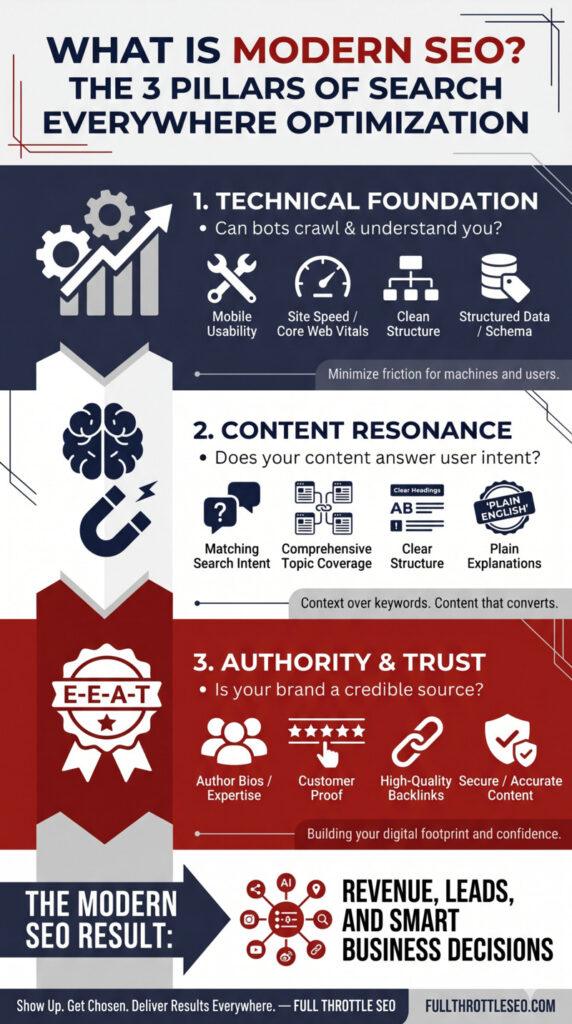
The three pillars of modern SEO are technical foundation, content resonance, and authority and trust.
SEO still matters because organic visibility can compound over time, support brand credibility, and reduce dependency on paid ads.
From Search Engines to Search Ecosystems
For years, SEO was mostly understood as the process of improving a website so it could rank higher in Google.
That definition made sense when most people searched by typing a phrase into Google, scanning a list of results, and clicking through to a website. But that is not how every search journey works anymore.
The biggest mindset shift is this: SEO is not just Google and Bing anymore. Those platforms still matter, but they are not the only places people search. Your customers may look for answers in AI tools, compare products on YouTube, check reviews, ask for recommendations on social media, browse Reddit threads, or validate your business through local search before they ever contact you.
The boundaries between these platforms are also disappearing. In July 2025, Instagram began allowing eligible public photos and videos from professional accounts to appear in search engines like Google and Bing. A Reel, carousel, or post is no longer limited to discovery within Instagram. It can potentially become an organic search result and introduce a brand to someone who has never visited its Instagram profile. Instagram explains the eligibility requirements and account controls in its guidance on how public content may appear in search engine results.
That means your SEO strategy cannot stop at “Can Google crawl my website?” That still matters, but it is only one piece of the puzzle.
Traditional SEO: Google and Bing Basics
Traditional SEO focuses on helping search engines discover, understand, and rank your website.
At a basic level, search engines work through three core steps:
- Crawling: Search engine bots discover pages on your website.
- Indexing: Search engines process and store information about those pages.
- Ranking: Search engines decide which pages are most relevant and helpful for a specific query.
If your website has technical issues, thin content, poor internal linking, confusing site structure, or weak authority signals, it becomes harder for search engines to understand why your page deserves visibility.
This is still foundational. A business cannot skip technical SEO, content quality, or authority building just because AI search is growing.
Social Search: TikTok, YouTube, Reddit, and Beyond
Search is not limited to traditional search engines anymore.
Social platforms are increasingly building products around deliberate search behavior. TikTok, for example, now offers keyword-based Search Ads Campaigns, allowing advertisers to reach people while they are actively searching for specific information, products, or ideas inside the platform.
According to research published by TikTok in partnership with WARC, TikTok users conduct billions of searches each day, with total searches increasing 40% year over year. The same research found that 86% of Gen Z internet users search on TikTok weekly. Although those figures come from TikTok-sponsored research, the platform’s investment in dedicated search advertising reinforces the larger shift in how people discover information. You can review the findings in TikTok’s report on how the platform is redefining search intent.
These users are not always looking for a polished company page. They may want a quick demonstration, a customer review, a comparison, a tutorial, or a more human explanation of a problem.
For businesses, this does not mean every brand needs to build a TikTok strategy or start publishing daily YouTube videos. It means understanding whether these platforms are part of your customers’ research journey and, when they are, considering how that visibility fits into the broader search strategy.
Google itself is beginning to treat off-site content as part of measurable search visibility. In 2026, Google introduced Search Console platform properties that allow creators to see how content published on Instagram, TikTok, YouTube, and X performs in Google Search and Discover. The reports include clicks, impressions, individual posts, and the search queries people used to discover that content.
When Google Search Console measures the organic visibility of social and video posts, it becomes increasingly difficult to argue that SEO begins and ends with a company’s website.
Search Everywhere Optimization looks at all of these touchpoints as part of the bigger visibility picture.
AI and Answer Engines: ChatGPT, Perplexity, Gemini, and AI Overviews
AI tools have changed how people collect information. Instead of clicking through several results, users can ask a tool like ChatGPT, Perplexity, or Gemini for a summarized answer that may include information from multiple sources.
These platforms are also developing their own search infrastructure. OpenAI operates OAI-SearchBot specifically to surface websites in ChatGPT’s search features. OpenAI distinguishes this search crawler from GPTBot, which is used for model training. This means businesses can make technical decisions that affect whether their content is eligible to appear in ChatGPT Search.
Google’s AI Overviews are also changing the search results page. In many searches, users may see an AI-generated response before traditional organic listings. That is one reason zero-click search behavior matters: users may get enough information from the results page without immediately visiting another website.
This does not mean websites are irrelevant. It means websites need to be easier for both humans and machines to access, understand, evaluate, and cite.
This is also why modern SEO is shifting toward answer engine visibility. People are not only searching in Google and Bing. They are using AI tools, search-integrated assistants, and platforms that summarize information for them. As more search journeys happen through AI-driven discovery, brands need clearer content, stronger trust signals, and a broader digital footprint.
Clear content, accessible information, credible third-party references, and consistent information about your brand can make it easier for search and AI systems to understand who you are and what you are relevant for. If your business is barely visible online, hard to understand, or inconsistent across platforms, you are making it harder for these systems to confidently surface your brand.
The Three Pillars of Modern SEO
Modern SEO has evolved, but the foundation has not disappeared. It still comes down to whether your website can be found, understood, trusted, and chosen.
The three pillars of modern SEO are:
- Technical foundation
- Content resonance
- Authority and trust
1. Technical Foundation
Technical SEO creates the foundation that allows search engines to access, understand, and properly index your website. That includes crawlability, indexing, site architecture, internal linking, performance, mobile usability, structured data, redirects, and other technical signals.
But technical SEO is not about chasing a perfect audit score. The priority should be fixing the issues that are actually limiting visibility, user experience, conversions, or your ability to grow.
Technical SEO also supports the page experience side of search. A slow, clunky, or difficult-to-use site can create friction for both users and search engines. That is why performance benchmarks like Core Web Vitals, mobile usability, and clean site structure still matter.
Schema markup is especially important in today’s search environment because it helps search engines and AI systems better understand what your content means. Think of schema as a map. It gives machines extra context about your business, services, products, reviews, FAQs, articles, events, and other important information.
2. Content Resonance
Old-school SEO often focused heavily on keywords.
Keywords still matter, but they are not enough.
Modern SEO is about understanding the topic, the intent behind the search, the user’s level of awareness, and what they need to feel confident taking the next step.
That means your content should not simply repeat the same keyword 15 times. It should answer the real questions your audience has before they buy, book, subscribe, call, or compare you against competitors.
Content resonance includes:
- Matching search intent
- Covering topics thoroughly
- Using clear headings and structure
- Answering related questions
- Explaining concepts in plain English
- Showing real experience
- Helping users make decisions
- Creating content that supports the customer journey
This is where entities matter, too.
An entity is a clearly identifiable thing, like a person, brand, product, service, location, organization, or concept. Search engines and AI tools use entities to understand relationships. For example, they may connect your brand to your services, location, industry, reviews, authors, products, case studies, and third-party mentions.
So yes, keywords matter.
But context matters more.
That is something I see repeatedly when reviewing client accounts. A page can be technically optimized around the “right” keyword and still underperform because it does not answer the questions customers actually have, address their objections, demonstrate enough expertise, or give them a compelling reason to choose the business.
Good SEO requires understanding both the search data and what happens after someone arrives.
Showing Up Is Not Enough
Showing up is only part of the job. A page can rank, get impressions, or bring in traffic and still fail if it does not help the visitor make a decision.
I see this often with ecommerce category pages that do little more than display product titles and product grids. There may be very little content explaining the product type, use cases, buyer considerations, comparisons, or why someone should buy from that brand.
Service pages can have the same problem in a different form. The content may be short, vague, or so “vanilla” that it could belong to any competitor in the market.
The other common issue is missing conversion opportunities. A page may technically exist, but there is no clear next step. No distinct button to book a call. No easy way to call or email. No newsletter signup. No path for someone who is interested but not ready to buy yet.
This is where SEO and conversion strategy have to work together. If the page creates friction, unclear messaging, or doubt, visibility alone will not fix the problem.
3. Authority and Trust
Search engines and AI systems do not just need to understand what you do. They need signals that your business is credible.
That is where authority and trust come in.
Google’s E-E-A-T framework stands for:
- Experience: Do you have real-world experience with the topic?
- Expertise: Do you know what you are talking about?
- Authoritativeness: Do others recognize you as a credible source?
- Trustworthiness: Can users and search engines trust your website, claims, business, and content?
This matters even more in a world where AI can mass-produce generic content. Anyone can publish a “complete guide” now. That does not mean the guide is useful, accurate, or based on actual experience.
That makes real experience, expertise, authority, and especially trust more important signals of content quality. The goal is not to claim expertise. It is to demonstrate why people should trust the information, the person behind it, and the business publishing it.
Trust is not created by adding the word “expert” to a page or publishing more generic content. It comes from evidence.
That evidence might include firsthand expertise, accurate author information, case studies, reviews, original examples, reputable third-party mentions, strong product or service information, and a consistent business presence across the web.
This is one reason I look beyond an individual page when evaluating SEO. Sometimes the content is not the real problem. The bigger issue may be weak proof, unclear positioning, poor reviews, inconsistent business information, or a website experience that gives potential customers very little reason to choose the company.
For local businesses, that may mean highlighting or embedding Google Business Profile reviews on the website. For ecommerce brands, it may mean collecting strong product reviews directly on the site. Testimonials, client logos, author bios, original photos, user-generated content, and clear process explanations can all help reinforce that your business is real, experienced, and worth considering.
These trust signals help search engines and AI systems understand your credibility as part of your broader digital footprint, but they also help real people feel more confident choosing you.
How Modern Search Works
Search has become more complex, but the basic process is still easier to understand when you break it down.
Here is the simplified version.
Step 1: Discovery
First, search engines, bots, crawlers, and AI systems need to find your information.
For traditional search engines, this usually starts with crawling, indexing, and ranking. Googlebot or Bingbot follows links, reads your sitemap, processes your pages, and decides when those pages may be relevant enough to appear for a search.
For AI systems and answer engines, discovery can also involve crawling, licensed data, third-party sources, citations, directories, forums, reviews, and other online mentions.
Google’s expanded partnership with Reddit shows how closely these different information environments are becoming connected. Through the partnership, Google gained structured access to fresher Reddit content to help it better understand and display that information across its products. Google explains that relationship in its announcement about the expanded Reddit partnership.
This is why your website cannot be your only visibility asset. If your brand is only mentioned on its own website, it may have a weaker digital footprint than a competitor appearing in reviews, articles, social content, videos, directories, and relevant customer discussions.
Step 2: Understanding
Once your content is discovered, machines need to understand it.
This is where indexing, natural language processing, entity recognition, structured data, and vectorization come into play.
You do not need to know every technical detail to understand the business impact. The point is this:
If your content is vague, thin, unstructured, outdated, or disconnected from how your customers actually search, machines may struggle to understand when and why to show it.
A strong page should make it clear:
- What the page is about
- Who it helps
- What problem it solves
- What service, product, or topic it connects to
- What makes the business credible
- What action the visitor should take next
This is one reason SEO and conversion strategy are so connected. A confusing page is not only harder for Google to understand. It is harder for a potential customer to trust.
Step 3: Retrieval
Retrieval is where your content gets selected, ranked, cited, summarized, or surfaced.
In traditional search, this might mean ranking on page one.
In AI search, this might mean being cited in a generated answer.
In social search, this might mean appearing in someone’s TikTok results, YouTube suggestions, or “For You” feed.
In a zero-click search, this might mean your content influences the answer even if the user does not click through immediately.
That can be frustrating for businesses that are used to measuring SEO only by clicks. But visibility still matters. If your brand is consistently showing up as part of the answer, you are building awareness, trust, and future demand.
The measurement needs to evolve with the search behavior.
Why Search Everywhere Matters for Your Business
SEO is not just a traffic channel. Done well, it supports visibility, trust, lead generation, sales, and brand preference.
But businesses need to stop thinking of SEO as “get me rankings” and start thinking of it as “make sure the right people can find and trust us when they are looking for what we offer.”
Sustainable Traffic
Paid ads can work, but the moment you stop paying, the traffic usually stops.
SEO works differently. It takes longer, but the work can compound. A strong service page, category page, article, video, or resource can continue attracting visibility long after it is published.
That does not mean SEO is free. It takes strategy, content, technical work, authority building, and ongoing updates. But over time, organic visibility can reduce your dependency on paid traffic.
This is especially important for businesses where ad costs keep rising or where customers take time to research before converting.
Brand Credibility
People trust what they repeatedly see.
If your business appears in Google results, AI Overviews, YouTube videos, Reddit conversations, local listings, industry articles, and helpful educational content, you create more opportunities for buyers to recognize and trust you.
That visibility supports more than clicks. It supports brand credibility.
When someone sees your business across multiple search touchpoints, they are more likely to think, “Okay, these people know what they are doing.”
That matters when they are choosing between you and a competitor.
Compound Returns
One of the biggest advantages of SEO is that good content can gain value over time.
A well-built page can earn links, rankings, impressions, engagement, and conversions month after month. It can be updated, expanded, repurposed, shared, and used in sales conversations.
Compare that to a one-time ad campaign that disappears when the budget runs out.
SEO is not instant. But when it is tied to business goals and executed consistently, it becomes an asset.
SEO Supports More Than Organic Search
SEO rarely operates in a vacuum. That is why I do not look at an organic search report without considering what else is happening across the business and its marketing.
Search data can tell us where demand exists and how people find the business. But conversion data, sales priorities, email performance, paid campaigns, customer behavior, website experience, seasonality, inventory, and internal business priorities can all change what the smartest SEO recommendation actually is.
For one ecommerce client, email marketing typically produced the strongest product conversion rates. That changed the SEO strategy. Instead of only asking, “What can rank?” we also looked at what articles could bring in targeted organic traffic and be repurposed in the email newsletter. The content supported search visibility, but it also gave the email channel stronger material to drive revenue.
For another client, data-driven SEO updates improved organic reach and increased leads, but the impact did not stop there. Traffic from direct, referral, social, and other sources also converted at a higher rate. A better experience for organic search often creates a better experience overall.
That does not make SEO responsible for every marketing channel. It means better SEO decisions come from understanding the broader business context.
SEO Should Guide Decisions
More traffic is not automatically better SEO. If the traffic is low-intent, poorly matched, or unlikely to turn into a lead or sale, it may make a report look better without helping the business.
The better question is: are we attracting higher-quality traffic that can increase quality leads, sales, or revenue?
SEO reporting should also guide decisions, not just document tasks. A useful report should not only say, “We updated these pages” or “We published these articles.” It should explain why the work was done, what happened afterward, what the outcome means, and what should happen next.
Sometimes the outcome is positive. Sometimes it tells us something did not work. Either way, the data should shape the strategy.
Measurement is also expanding as search changes. OpenAI automatically adds utm_source=chatgpt.com to referral links from ChatGPT Search, allowing businesses to identify visits from those results in platforms such as Google Analytics. OpenAI explains this tracking capability in its publisher and developer guidance.
Some SEO platforms are also beginning to track brand mentions, citations, and visibility within tools such as ChatGPT, Perplexity, Gemini, and Google’s AI features. And GA4 now includes an AI Assistant Channel. These measurements are still evolving, but they show why modern visibility cannot be evaluated through traditional keyword rankings alone.
Search Everywhere Does Not Mean Equal Effort Everywhere
Search Everywhere Optimization does not mean your business needs an SEO strategy for every platform.
It means understanding the search and research environments that actually influence your customers, then deciding where visibility matters enough to deserve your attention and resources.
The focus should come from strategy.
Where are your ideal clients actually spending time? What do they need to hear before they trust you? Is your messaging consistent across the places where your brand does show up?
SEO can help answer those questions because search data shows what people ask, what they compare, what problems they are trying to solve, and what content gaps exist. That insight can support website strategy, content planning, social topics, email ideas, and even sales conversations.
Common SEO Myths
SEO has changed a lot, and unfortunately, some of the advice floating around has not caught up.
Here are a few myths worth clearing up.
Myth 1: SEO is dead.
SEO is not dead. Search behavior changed.
People still need to find products, services, businesses, expertise, and answers. What has changed is where they search, how they phrase those searches, what appears in the results, and how much research may happen before they ever visit a website.
Google still matters. But so do AI tools, video platforms, social search, local results, review platforms, marketplaces, and third-party mentions.
The businesses that struggle are usually the ones still treating SEO like it’s 2013.
Myth 2: Keywords are all that matter.
Keywords are part of SEO, but they are not the whole strategy.
If someone searches “best running shoes for flat feet,” the keyword matters. But the intent matters more. That person may want product comparisons, expert recommendations, reviews, sizing guidance, or a clear explanation of what features to look for.
Modern SEO needs to understand the full context behind the search.
That includes:
- What the user wants
- What stage of the buying journey they are in
- What questions they need answered
- What objections they may have
- What proof they need before taking action
If you only focus on keywords, you may get visibility without conversions. That is not the goal.
Myth 3: More content means better SEO.
Publishing more content does not automatically help you rank.
In fact, mass-producing generic AI content can hurt your brand if it creates thin, repetitive, unhelpful pages. AI can help with research, outlines, content repurposing, and optimization, but it still needs human strategy and oversight.
The goal is not to publish the most content.
The goal is to publish the right content, for the right audience, with enough depth and credibility to be useful.
AI can synthesize existing information quickly, but that is not the same as bringing firsthand experience, original research, customer insight, or real practitioner perspective to the content. Those are the things businesses need to contribute if they want their content to offer something beyond another generic summary of information that already exists.
Myth 4: AI can just write my SEO pages for me.
One of the biggest mistakes businesses make right now is assuming they can ask their preferred AI tool to “write an SEO service page” or “write a product page” and call it done.
AI can help, but it does not automatically understand what your customers are searching, what questions they ask before buying, what concerns stop them from converting, or what gaps exist on competitor pages. Without that strategy, AI content often becomes generic content with SEO words sprinkled in.
AI search also still relies heavily on outside signals. Much like traditional Google or Bing search, AI tools need context from credible sources across the web. Reviews, online mentions, backlinks, third-party references, and consistent brand signals all still matter.
Frequently Asked Questions About SEO
Can I do SEO myself?
Yes, you can do some SEO yourself, especially if you are willing to learn the basics and stay consistent.
Business owners and marketing teams can often handle things like:
- Updating page titles and meta descriptions
- Writing helpful content
- Improving internal links
- Adding FAQs
- Updating old blog posts
- Asking for reviews
- Improving Google Business Profile information
- Creating better service or product page copy
But SEO gets more complex when you are dealing with technical issues, competitive markets, site migrations, ecommerce category strategy, content architecture, link building, schema, reporting, or AI search visibility.
DIY SEO can work up to a point. The risk is spending months doing random tasks without knowing whether they support the bigger business goal.
How long does SEO take to see results?
It depends on the website, competition, market, budget, and starting point.
Some fixes can create movement quickly, especially if your website has obvious technical problems or poorly optimized pages. But meaningful SEO growth usually takes time.
For many businesses, early improvements may show within the first few months, while stronger revenue-impacting results often take 6 to 12 months or more. Highly competitive industries can take longer.
That does not mean you should wait a year to know whether SEO is working. You should be tracking leading indicators along the way, such as:
- Indexing improvements
- Keyword movement
- Organic impressions
- Click-through rates
- Engagement
- Conversions
- Branded search
- Assisted conversions
- Visibility in AI or blended search results
- Revenue or lead quality from organic traffic
SEO should not be a mystery box. You may not control every algorithm update, but you should be able to see whether the strategy is moving in the right direction. And some of that is going to take time and patience.
Is SEO the same as GEO?
Not exactly.
SEO traditionally stands for Search Engine Optimization. GEO usually stands for Generative Engine Optimization, which focuses on improving visibility in AI-generated answers from tools like ChatGPT, Perplexity, Gemini, and AI Overviews.
But GEO should not be treated as a completely separate strategy.
Google’s guidance supports the idea that AI visibility is connected to the existing foundations of SEO. Google says its generative AI features are rooted in its core Search ranking and quality systems and that the same foundational SEO practices continue to apply. In its guidance on optimizing for generative AI features, Google goes as far as saying that, from its perspective, optimizing for generative AI search is still SEO.
I agree that the foundation remains SEO. But the environment in which that foundation operates is now much larger.
I do not treat GEO or AEO as replacements for SEO. I see AI search visibility as an extension of the same broader discipline.
The fundamentals still matter: technically accessible content, clear answers, topical relevance, real expertise, authority, trust, and a strong presence beyond your own website.
Search Everywhere Optimization is the lens I use to look at those fundamentals across the broader search journey: Where does this business need to show up? What will make customers choose it? And is that visibility producing meaningful results?
Actionable Recommendations for Modern SEO Success
If you want to improve your search visibility today, start with the pieces that make your brand easier to find, understand, and trust.
1. Define your core topics clearly.
Do not start with random blog ideas. Start with the topics your business needs to be known for.
Ask:
- What services, products, or categories matter most to revenue?
- What questions do customers ask before they buy?
- What objections slow down the sales process?
- What comparisons are they making?
- What proof do they need?
- What expertise do we have that competitors are not showing clearly?
Your content strategy should support the buying journey, not just fill a blog calendar.
2. Strengthen your technical foundation.
Before chasing every new AI search tactic, make sure your website is technically sound.
Start with the issues that can materially affect crawling, indexing, site performance, internal linking, user experience, and your most important pages.
The priority will vary by website. A technical issue affecting an important ecommerce category or lead-generating service page deserves more attention than an audit warning with little practical impact.
If search engines cannot properly crawl and understand your website, everything else gets harder.
3. Prioritize opportunities instead of doing SEO tasks at random.
Not every SEO opportunity deserves the same resources. Look for the intersection between search opportunity and business value: pages already gaining traction, products or services tied to revenue, content gaps affecting the buying journey, technical problems holding important pages back, and opportunities where relatively focused work could create meaningful improvement.
The goal is not to complete the biggest SEO checklist. It is to identify what is most likely to move the business forward.
4. Use structured data where it makes sense.
Schema markup helps search engines understand your content more clearly.
Useful schema types may include:
- Organization schema
- LocalBusiness schema
- Product schema
- Review schema
- FAQ schema
- Article schema
- Service schema
- Breadcrumb schema
- SoftwareApplication schema, if applicable
Do not add schema just to check a box. Use it to clarify what the page actually contains.
5. Optimize for zero-click visibility.
Zero-click searches are not going away.
Instead of fighting them, structure your content so it has a better chance of being used in featured snippets, AI Overviews, and answer-style results.
That means:
- Answer important questions clearly
- Use concise definitions near the top of the page
- Add key takeaways
- Use descriptive headings
- Include FAQ sections
- Break complex ideas into scannable sections
- Support claims with credible sources
- Add original examples and experience
You still want clicks. But you also want your brand to influence the answer, even when the search journey does not start with a website visit.
6. Build authority beyond your website.
Your website matters, but your digital footprint matters too.
Look for ways to earn visibility through:
- Guest features
- Podcast appearances
- PR mentions
- Industry directories
- Partner pages
- Customer reviews
- Case studies
- YouTube content
- Social search content
- Reddit or community mentions
- LinkedIn thought leadership
- High-quality backlinks
The more credible and consistent your brand presence is across the web, the easier it becomes for search engines, AI systems, and customers to understand why you are a trustworthy option.
SEO Advice Should Come With Context
My perspective on SEO comes from working directly with businesses across ecommerce, healthcare, professional services, automotive, manufacturing, and local markets. I have seen SEO contribute to measurable growth in organic revenue, lead generation, conversions, and search visibility, but I have also seen why the same playbook does not work for every business.
The right strategy depends on the business model, customer journey, competitive environment, internal resources, revenue priorities, and what the data is actually telling us.
That is why my approach to SEO is less about checking boxes and more about deciding what deserves attention next.
Final Thoughts
The main thing to understand is this: SEO is still about helping the right people find your business when they are looking for what you offer. What has changed is the search journey around it.
Traditional search engines still matter. AI-generated answers, local results, reviews, video, marketplaces, and other research environments increasingly influence what people discover and which businesses they trust.
But more visibility is not automatically better SEO.
The goal is to show up in the places that matter, give the right people a reason to choose you, and turn that visibility into meaningful business results.
That is how I think modern SEO should be approached.
Show Up. Get Chosen. Deliver Results.
If you are not sure whether your SEO strategy is helping your business do all three, that is where we can help. Full Throttle SEO works with businesses that want more than rankings. We look at how your brand shows up, whether your website gives people a reason to choose you, and whether your SEO efforts are supporting leads, sales, revenue, and better marketing decisions.
Explore our SEO services or contact us to start a conversation about your current search visibility and where the biggest opportunities may be.
Updated September 2026 to include recent changes in social and AI search.

J. “Ivy” Boyter is the founder of Full Throttle SEO, a Florida-based SEO consultancy. With nearly 15 years of digital marketing experience, she helps businesses turn search visibility into qualified leads and revenue, with a focus on ecommerce SEO, technical audits, and visibility in AI-powered search. Her approach connects SEO priorities to business goals, helping brands show up, get chosen, and deliver results.
Outside of work, Ivy competes in autocross and rallycross, wrangles kids and chickens, and writes heartfelt marriage and parenting advice.