
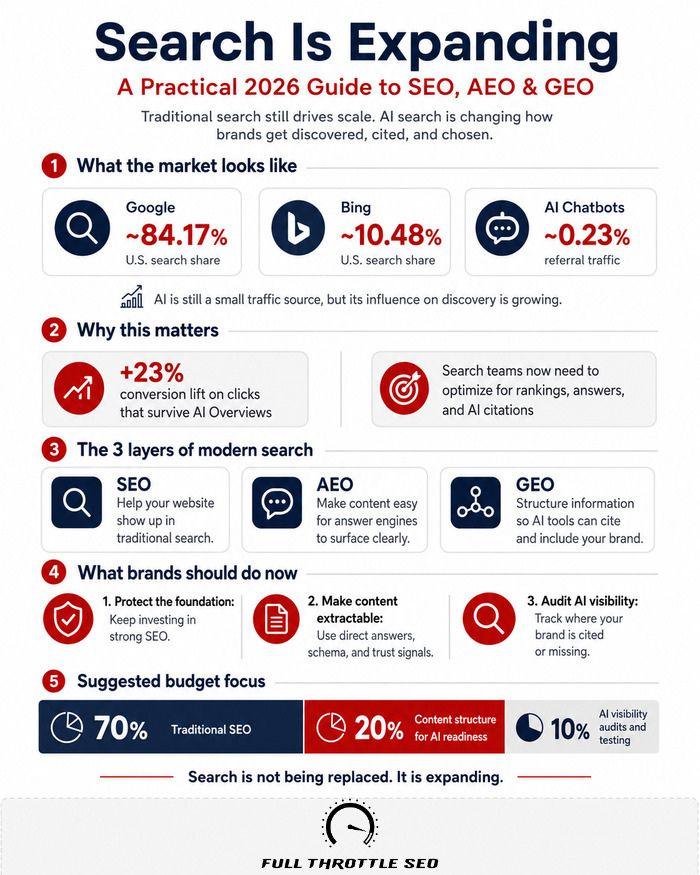
Search is not being replaced by AI. It is expanding. In 2026, brands still need strong SEO to capture traditional search demand, but they also need content that answer engines and generative AI tools can understand, trust, and cite. This guide explains how SEO, AEO, and GEO fit together, why traditional search still matters, and what brands should prioritize to stay visible as search behavior continues to evolve.

Search Is Not Being Replaced. It Is Expanding.
There is a lot of noise right now around the so-called “search wars.”
Google versus ChatGPT. Traditional SEO versus AI search. Blue links versus AI answers.
But for marketing leaders, that framing is too narrow.
We are not watching old search get completely replaced by something new. We are watching search expand into more platforms, formats, and interfaces, with AI-powered search already influencing how consumers discover and evaluate brands.
The goal has not changed. Your brand still needs to show up when your customers are looking for answers, comparing options, and deciding who to trust.
What has changed is where and how those searches happen.
To make sense of this, it helps to define a few key terms in plain English:
- SEO, or Search Engine Optimization: Helping your website show up when someone searches on Google, Bing, or another traditional search engine.
- AEO, or Answer Engine Optimization: Structuring content so answer-based tools, including voice assistants and AI-powered search features, can provide a clear answer.
- GEO, or Generative Engine Optimization: Organizing your information so AI tools like ChatGPT, Gemini, and Perplexity can understand, reference, and include your brand in generated responses.
The mistake is treating these as completely separate channels with separate strategies.
They are not.
SEO, AEO, and GEO are different layers of the same larger visibility strategy. The interface may be changing, but AI tools still need clear, trustworthy, accessible information to pull from.
And when we look at current search behavior, one thing becomes clear: AI search matters, but traditional search is still doing the heavy lifting.
The Volume vs. Quality Paradox: Why We Cannot Abandon the 84%
Marketing teams have to balance two things at once: where the traffic volume is coming from and where the highest-intent traffic may be emerging.
It is tempting to chase the newest thing and shift attention heavily toward AI search. But based on current market share data, walking away from traditional search would be premature.
As of 2026, the search market still looks heavily weighted toward traditional search, especially on mobile, where Google continues to dominate global search behavior.
| Search Platform | U.S. Market Share / Referral Traffic |
|---|---|
| ~84.17% | |
| Bing | ~10.48% |
| AI Chatbots, including ChatGPT, Perplexity, etc. | ~0.23% |
Google still holds approximately 84.17% of U.S. search market share, while its global share remains even higher at approximately 89.85%.
That matters.
You cannot ignore the channel still responsible for the overwhelming majority of search activity, even as many searches now end without a website click.
But the small AI referral number does not mean AI search is irrelevant. AI search query volume is growing quickly, even if that activity does not always translate into traditional website clicks.
The paradox is this: AI chatbots currently drive a very small share of referral traffic, and some of that AI referral traffic may be undercounted in analytics, but the users who do click through from AI-influenced experiences may be much further along in the decision-making process.
Data indicates a +23% conversion lift on clicks that survive AI Overviews. That suggests that when a user does click after seeing an AI-generated answer, they may already be more informed, more qualified, and closer to taking action.
So the strategic takeaway is not “abandon SEO for AI.”
It is this:
You still need to win traditional search volume, but your SEO strategy also needs to support how AI tools discover, understand, and cite your brand.
Your SEO Strategy Is Still the Foundation of Your AI Search Strategy
One of the biggest misconceptions about AI search is that AI tools simply “create” answers from scratch.
That is not really how this works.
Large language models and AI search tools rely heavily on existing information sources. They extract, summarize, synthesize, and cite information from the web, databases, and other accessible sources.
So if your content is unclear, thin, poorly structured, or difficult for search engines to understand, it is also harder for AI tools to understand.
That is why SEO still matters.
In many cases, SEO is the foundation that makes AI visibility possible.
The data also shows that AI citations are not evenly distributed across the web. Research from BrightEdge and Ahrefs indicates that 40–55% of citations in ChatGPT Search and Perplexity flow to fewer than 1,000 high-authority domains.
That means visibility is getting more concentrated, not less.
If your brand is not already building authority, publishing useful content, earning trust signals, and making information easy to extract, AI search is unlikely to magically solve the visibility problem.
It may actually make the gap bigger.
The Apple and Google alignment reinforces this point. Apple’s multi-billion-dollar partnership with Google, including the reported use of Google’s Gemini models to power parts of Apple Intelligence, shows that major AI experiences are still deeply connected to existing search and data infrastructure.
And as we move toward more agentic AI experiences, this becomes even more important.
By the end of 2026, 40% of enterprise applications are projected to include task-specific AI agents. These systems will not just answer questions. They will help users compare, decide, and take action.
But they still need clean, trustworthy, structured information to work from.
That means your website, content, schema, reviews, product/service information, and authority signals all matter.
AI Search Will Not Impact Every Query the Same Way
AI is not affecting all search behavior equally, but traditional search volume is projected to decline as users shift some research behavior to AI-powered chatbots.
Informational searches are being disrupted much more aggressively than transactional, branded, or high-intent searches.
In other words, AI may reduce clicks on broad research queries, but people still visit websites when they are ready to compare, contact, buy, book, or validate a provider.
Here is how the impact is showing up across different content types and industries:
| Industry Segment | YoY Organic Traffic Change | Dominant Driver |
|---|---|---|
| Health and Medical Information | -35% to -50% | AI Overviews + ChatGPT |
| How-to and Reference Content | -30% to -45% | AI Overviews + ChatGPT |
| Travel Content Sites | -15% to -25% | AI Mode + Google Maps |
| B2B SaaS Product Content | -3% to -12% | Copilot + Perplexity |
| Branded and Direct-Response | Flat to +5% | Minimal AI Disruption |
This is why marketing teams need to look at search more strategically.
Not every traffic loss is equally damaging.
If your blog traffic drops because AI answers simple top-of-funnel questions directly, that may hurt reporting. But if your service pages, product pages, category pages, and branded search visibility are still driving qualified leads and revenue, the business impact may be very different.
The strategic question is not just, “Did traffic go up or down?”
The better question is:
Where is AI reducing visibility, where is it influencing the buyer journey, and where does your brand still need to win the click?
Transactional content still needs strong SEO. Research-stage content needs to be structured so AI tools can understand and cite it, especially as research-intensive queries move into AI search tools like Perplexity.
This is also why SEO reporting needs to go beyond rankings and traffic and help marketing teams understand what is actually driving visibility, leads, and revenue.
The New Tactical Layers: Make Your Content Easier to Understand, Extract, and Trust
To compete in this next stage of search, content needs to be more than optimized for keywords.
It needs to be easy to understand, easy to extract, and easy to trust.
There are three tactical layers that matter most:
1. Direct-answer summaries
Important pages should include a clear, concise answer near the top. This may be a 2–3 sentence summary that explains what the page is about, who it helps, and why it matters.
Content that leads with clear answers is cited 2–3x more often by AI search engines than pages where the answer is buried.
That does not mean every page should sound robotic. It means your content should stop making people, search engines, and AI tools work too hard to understand the point.
2. Structured data and schema
Schema acts like a set of labels for your content.
Organization schema, Person schema, FAQ schema, Product schema, Service schema, and other structured data can help search engines and AI systems better understand what your content means.
This does not replace strong content. But it can make your information more machine-readable and easier to interpret.
3. E-E-A-T signals
AI models and search engines both rely on trust signals.
Experience, Expertise, Authoritativeness, and Trustworthiness still matter. This can include author bios, original insights, expert review, testimonials, case studies, reviews, citations, proprietary data, and clear company information.
Current citation patterns also show that AI tools tend to favor well-known authority sources. Reddit reportedly holds an 18% citation share on ChatGPT, alongside other high-authority sources like Wikipedia and major news outlets.
That does not mean every brand needs to become Reddit or Wikipedia.
But it does mean brands need to stop publishing generic, interchangeable content.
Originality is becoming more valuable.
First-party data, proprietary research, expert insights, customer stories, and real-world examples are harder for competitors to copy and more valuable for both human buyers and AI systems.
A Practical 2026 Search Budget Roadmap
The goal is not to throw out what already works.
The goal is to evolve your search strategy so it supports how buyers search now and how they will search next.
A practical phased approach may look like this:
Phase 1: The Foundation, 70% of Budget
Maintain the majority of investment in strategic SEO services that strengthen technical performance, content quality, authority, and conversion-focused visibility.
This is still where most search volume lives, especially for transactional, commercial, branded, local, product, and service-based searches.
This includes technical SEO, site structure, internal linking, keyword strategy, content optimization, product and service page improvements, and conversion-focused updates.
Phase 2: The Structure, 20% of Budget
Invest in making your content easier for both search engines and AI tools to understand.
This includes adding direct-answer sections, improving content structure, implementing schema, strengthening E-E-A-T signals, refreshing outdated content, and making key pages more useful and specific.
This is where a broader Search Everywhere strategy starts to take shape. Your content should not only rank. It should be clear enough to be referenced, cited, summarized, and trusted across search engines, AI tools, and other discovery platforms.
Phase 3: The Frontier, 10% of Budget
Audit your visibility in ChatGPT, Perplexity, Gemini, and other AI-driven discovery tools.
Look for where your brand is mentioned, where competitors are being cited, which sources AI tools appear to trust, and what gaps exist in your content.
Then use those insights to improve your SEO strategy, not replace it.
AI visibility should inform your content, authority, and positioning decisions. It should not become a disconnected side project.
The Tools Are Changing, but the Goal Is Not
Search in 2026 feels more complex because it is happening across more surfaces.
People are still using Google. They are also using AI tools, social platforms, review sites, maps, marketplaces, videos, and communities to make decisions.
But the core behavior has not changed.
People want clear, trustworthy, useful answers.
They want to know who understands their problem. They want to compare options. They want proof. They want confidence before they act.
The brands that win will not be the ones chasing every new search trend in isolation.
They will be the ones building a stronger visibility system across traditional search, AI search, and the full customer journey.
Show up where your customers are searching.
Make it easy for them to understand why you are the right choice.
Then make sure that visibility turns into real business results.
If your team is trying to understand how SEO, AI search, and revenue-focused visibility fit together, contact Full Throttle SEO to talk through where you are now and what needs to improve next.

J. “Ivy” Boyter is the founder of Full Throttle SEO, a Florida-based SEO consultancy. With nearly 15 years of digital marketing experience, she helps businesses turn search visibility into qualified leads and revenue, with a focus on ecommerce SEO, technical audits, and visibility in AI-powered search. Her approach connects SEO priorities to business goals, helping brands show up, get chosen, and deliver results.
Outside of work, Ivy competes in autocross and rallycross, wrangles kids and chickens, and writes heartfelt marriage and parenting advice.