
If you have been wondering what role does page speed play in ecommerce SEO, the answer is simple. It plays a major role. Page speed affects how well your store ranks, how easily search engines crawl your pages, and whether shoppers stay long enough to buy. In ecommerce, faster pages support SEO performance, improve user experience, and increase conversions.
Slow ecommerce sites do not just frustrate shoppers. They quietly choke off rankings, reduce conversions, and make it harder for search engines to do their job.
That is what makes page speed one of those rare ecommerce SEO issues that touches almost everything at once. It affects visibility. It affects user experience. It affects sales. If you are running an online store with dozens, hundreds, or thousands of product and category pages, even small performance issues can become expensive over time.
The good news is that page speed is one of the clearest areas where technical improvements can create real business impact.
Table of Contents
What Role Does Page Speed Play in Ecommerce SEO?
Page speed plays a critical role in ecommerce SEO because it affects search rankings, user experience, crawl efficiency, and conversion rates. Faster ecommerce sites allow search engines to crawl more pages efficiently while providing shoppers with a smoother browsing experience. When product and category pages load quickly, visitors are more likely to stay on the site, explore products, and complete purchases.
What role does page speed play in ecommerce SEO? It plays both a direct and indirect role in how your store performs in organic search.
Directly, page speed is part of Google’s evaluation of page experience. Google has confirmed that speed matters, and that expectation is now reflected through Core Web Vitals and mobile-first indexing. If your site is extremely slow, it can make it harder to compete in search results.
Indirectly, page speed affects the signals that matter most in ecommerce. These include bounce rate, engagement, product exploration, add-to-cart behavior, and completed purchases. A faster site makes it easier for shoppers to browse, interact, and convert. A slower site creates friction at every step.
For ecommerce brands, page speed influences SEO in several ways:
- Search rankings – Faster pages support better page experience signals.
- Core Web Vitals performance – Speed affects LCP, INP, and CLS metrics.
- User engagement – Faster sites reduce bounce rates and increase time on site.
- Crawl efficiency – Search engines can crawl more pages when servers respond quickly.
- Conversion rates – Faster product pages improve the likelihood of completing a purchase.
Page speed is not the only factor in ecommerce SEO. It works alongside many other elements covered in modern ecommerce SEO best practices.
Page Speed Is a Ranking Factor. The Real Story Is Bigger
Many articles stop with the statement that page speed is a ranking factor. That is true, but it does not tell the whole story.
Yes, page speed matters for rankings. The bigger issue is that Google wants to rank pages that create a good user experience. Pages should load quickly, respond quickly, and avoid visual instability while loading.
In other words, the real question is not simply whether a page loads. The real question is whether the page becomes usable fast enough for a shopper to interact with it.
That difference matters in ecommerce.
A blog post can sometimes get away with being slightly slow. A product page, category page, or checkout page usually cannot. If a shopper lands on a category page and the filters lag, the images take too long to load, or the layout shifts unexpectedly, the experience breaks down quickly.
Before diving deeper into performance metrics, it helps to define what page speed actually means. Page speed refers to how quickly a webpage loads and becomes usable for visitors. For ecommerce websites, this includes how fast product images appear, how quickly filters respond, and how smoothly shoppers can interact with the page.
Core Web Vitals and Why They Matter for Ecommerce SEO
Google uses Core Web Vitals to measure real-world page performance and user experience. According to Google’s Core Web Vitals documentation, these metrics evaluate loading performance, responsiveness, and visual stability to determine whether pages deliver a good experience.
These metrics help determine whether a page feels fast and stable for users.
Largest Contentful Paint (LCP)
LCP measures how long it takes for the main visible content on the page to load. On ecommerce pages, this is often a large image, banner, or product display element.
A good target is under 2.5 seconds.
Interaction to Next Paint (INP)
INP measures how quickly the page responds when users interact with it. This includes clicks, taps, filter selections, or menu actions.
A good target is under 200 milliseconds.
This metric matters for ecommerce because shoppers constantly interact with the page while browsing products.
Cumulative Layout Shift (CLS)
CLS measures visual stability. It tracks whether elements move unexpectedly while the page loads.
A good target is below 0.1.
Unexpected shifts can cause shoppers to misclick or lose their place on the page. That creates a frustrating experience.
Why Page Speed Has an Outsized Impact on Ecommerce Sites
All websites benefit from being faster. Ecommerce sites simply have more to lose when they are slow.
Here are a few reasons why page speed matters even more in ecommerce SEO.
Ecommerce pages are usually heavier
Online stores rely heavily on product images, scripts, plugins, reviews, and merchandising tools. All of these elements add weight to the page.
Product discovery depends on speed
Shoppers often move quickly between category pages and product pages while comparing options. If each page takes too long to load, that discovery process becomes frustrating.
Mobile users are less patient
Many ecommerce visits happen on mobile devices. These users may have slower connections and less patience for delays.
Checkout delays cost real money
Slow cart or checkout pages create friction near the point of sale. That is where speed issues can directly reduce revenue.
For these reasons, page speed should be viewed as part of the overall customer experience.
How Page Speed Affects User Experience and Conversion Rates
A slow site does not just cause mild annoyance. It changes behavior.
When product pages load slowly, shoppers are more likely to leave before engaging. When category pages feel sluggish, users browse fewer products. When checkout takes too long, carts are abandoned.
Research consistently shows that even small delays can affect ecommerce performance. Google research on page load speed found that the probability of a bounce increases dramatically as page load time rises from one to five seconds.
This is why page speed improvements often benefit both SEO and conversion rates at the same time.
Page Speed Can Influence Crawl Efficiency and Indexing
This issue becomes especially important for large ecommerce sites.
Search engines crawl websites by requesting pages from the server. When pages load quickly and respond efficiently, search engines can crawl more URLs within a given timeframe.
This helps search engines discover and index product pages, category pages, and updates more efficiently.
For ecommerce sites with large catalogs, crawl efficiency can affect:
- New product visibility
- Updated pricing or availability pages
- Seasonal category changes
- Large catalog indexing
A slow site can make it harder for search engines to process and update your content.
Mobile Speed Matters More Than Ever
Mobile performance deserves special attention.
Google uses mobile-first indexing, which means the mobile version of your site is the primary version evaluated for rankings.
Many ecommerce shoppers also browse on their phones while multitasking. If your mobile site is slow or difficult to interact with, visitors will leave quickly.
Common causes of slow mobile performance include:
- oversized images
- heavy JavaScript
- too many plugins or apps
- intrusive popups
- inefficient mobile layouts
Improving mobile page speed supports both SEO visibility and better user experience.
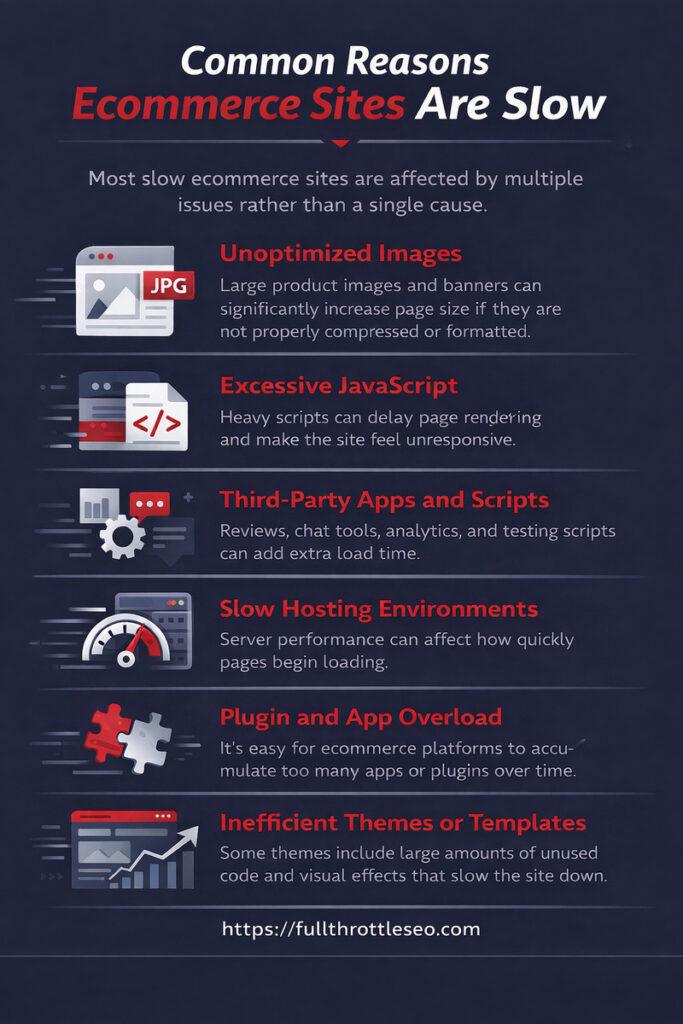
Common Reasons Ecommerce Sites Are Slow
Most slow ecommerce sites are affected by multiple issues rather than a single cause.
Unoptimized images
Large product images and banners can significantly increase page size if they are not properly compressed or formatted.
Excessive JavaScript
Heavy scripts can delay page rendering and make the page feel unresponsive. Resources like JavaScript performance optimization guidance from MDN explain how inefficient scripts can block the main thread and slow down page interaction.
Third-party apps and scripts
Reviews, chat tools, analytics, personalization tools, and testing scripts can add extra load time.
Slow hosting environments
Server performance can affect how quickly pages begin loading.
Plugin and app overload
It is easy for ecommerce platforms to accumulate too many apps or plugins over time.
Inefficient themes or templates
Some themes include large amounts of unused code and visual effects that slow the site down.
The Performance Paradox Ecommerce Brands Should Watch
Modern ecommerce sites often add tools designed to improve marketing performance. These might include testing platforms, personalization tools, and tracking scripts.
Unfortunately, some of these tools can also slow down the website.
When performance tools add too much latency, they can unintentionally harm the user experience they were meant to improve.
This does not mean testing or tracking should stop. It simply means that performance should be considered when evaluating new tools.
How to Improve Page Speed for Ecommerce SEO
Improving page speed does not require fixing everything at once. Focus first on the issues that have the largest impact on user experience.
Optimize product images
Use modern formats such as WebP or AVIF when possible. Compress images and resize them appropriately.
Prioritize above-the-fold content
Ensure the most important content loads first so users can immediately interact with the page.
Audit JavaScript
Reduce unnecessary scripts and defer non-critical code when possible.
Limit third-party scripts
Remove tools that are not delivering measurable value.
Use a content delivery network
A CDN can reduce latency by serving content closer to the user.
Improve server response times
Better hosting and caching strategies can improve performance.
Lazy load lower page elements
Allow images and media further down the page to load only when needed.
Monitor Core Web Vitals regularly
Performance should be monitored continuously because ecommerce sites change frequently.
Tools like Google PageSpeed Insights can help identify performance issues affecting Core Web Vitals and real-world user experience.
What Is a Good Page Speed for Ecommerce?
There is no single number that guarantees success. However, healthy Core Web Vitals metrics provide a strong benchmark.
Good targets include:
- LCP under 2.5 seconds
- INP under 200 milliseconds
- CLS under 0.1
More importantly, the page should feel fast and responsive to users.
Page Speed Is Only One Part of Ecommerce SEO
A fast site alone will not guarantee strong rankings.
Successful ecommerce SEO also requires:
- optimized product pages
- strong internal linking
- clear site architecture
- structured data
- relevant content
- strong keyword targeting
Page speed works best when it supports the broader SEO strategy. Ecommerce brands that want stronger organic growth typically combine performance improvements with technical SEO, optimized product pages, internal linking, and structured data. Businesses that need help implementing these improvements often work with professional ecommerce SEO services to address both performance and search visibility together.
If you are building a comprehensive optimization plan, resources like an ecommerce SEO checklist and practical ecommerce SEO best practices can help connect performance improvements with the rest of your strategy.
Final Answer: What Role Does Page Speed Play in Ecommerce SEO?
Page speed plays a major role in ecommerce SEO because it affects both user experience and search engine evaluation.
Fast sites support stronger rankings, lower bounce rates, improved crawl efficiency, and higher conversion rates. Slow sites create friction that can limit traffic and revenue.
For ecommerce businesses competing in search results, page speed is not just a technical metric. It is a competitive advantage.
FAQs About Page Speed and Ecommerce SEO
How does page speed impact SEO?
Page speed impacts SEO by influencing page experience, Core Web Vitals, crawl efficiency, and user engagement signals.
What role does website speed play in user experience and SEO?
Website speed affects how quickly users can interact with content. Faster pages create smoother experiences that support stronger SEO performance.
Does mobile page speed matter for ecommerce SEO?
Yes. Mobile speed is extremely important because Google uses mobile-first indexing and many ecommerce shoppers browse on mobile devices.
What page speed is considered good for ecommerce websites?
A good page speed for ecommerce sites typically means loading primary content in under 2.5 seconds while maintaining strong Core Web Vitals scores. Faster sites improve user experience, reduce bounce rates, and help search engines crawl product pages more efficiently.

J. “Ivy” Boyter is the founder of Full Throttle SEO, a Florida-based SEO consultancy. With nearly 15 years of digital marketing experience, she helps businesses turn search visibility into qualified leads and revenue, with a focus on ecommerce SEO, technical audits, and visibility in AI-powered search. Her approach connects SEO priorities to business goals, helping brands show up, get chosen, and deliver results.
Outside of work, Ivy competes in autocross and rallycross, wrangles kids and chickens, and writes heartfelt marriage and parenting advice.