
Monthly SEO reports should be impactful, but most reports stop at metrics and fail to explain what’s actually driving business results. Without clear connections between actions, visibility, and revenue or pipeline, marketing teams are left interpreting data instead of making confident decisions. When reporting shifts from dashboards to insight, it becomes a strategic tool that guides what to do next, not just what already happened.
You’re getting the reports.
Rankings are up. Traffic looks steady. Impressions are growing. Maybe even conversions are trending in the right direction. Most of the time, these reports come through dashboards or PDFs built in tools like Data Studio (formerly Looker Studio) or AgencyAnalytics, and on the surface, everything looks solid.
But when someone asks what’s actually driving revenue or pipeline, the answer usually isn’t clear. That’s where things start to break down, and it’s also where most SEO reporting stops being useful.

What SEO reporting usually looks like (especially with agencies)
If you’re working with an SEO consultant or agency, your monthly SEO reporting probably follows a familiar pattern.
You get a dashboard or PDF built using SEO reporting tools. It includes keyword rankings, organic traffic, impressions, and sometimes conversions, along with a short summary of what was done that month. Everything is organized, consistent, and easy to scan.
And to be clear, none of that is inherently wrong.
These reports are useful for tracking performance at a high level. They help you monitor trends, identify movement, and keep a pulse on your search visibility. Most marketing teams expect to see at least the following in SEO analytics and reporting:
- Keyword rankings and movement over time
- Organic traffic and user trends
- Impressions and click-through rates
- Conversions or goal completions tied to organic traffic
- A list of completed deliverables or optimizations
The issue is that most of this reporting is structured around delivery, not decision-making.
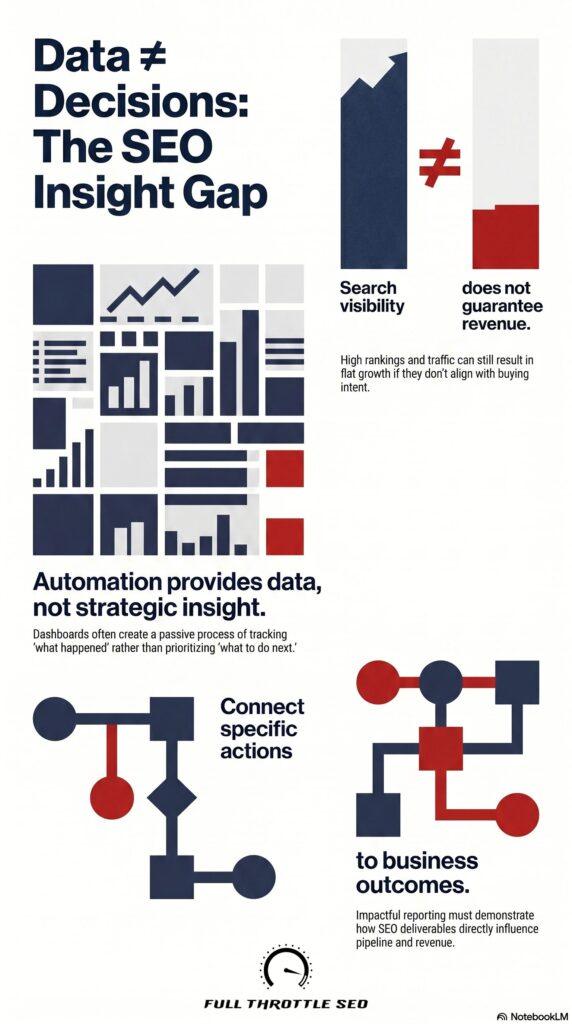
It shows what happened, but it doesn’t clearly connect what work was done, how that work influenced performance, and what that actually means for the business. So you’re left trying to interpret the data and fill in the gaps yourself.
Why this becomes a problem for marketing teams
On the surface, SEO monthly reporting checks the box.
You’re getting updates. You’re seeing movement. You have something to share with leadership. But when you’re responsible for performance, that’s not enough to confidently guide strategy or defend budget.
At some point, you need to answer questions like:
- What’s actually driving growth right now?
- Are we investing in the right areas?
- Which efforts are influencing revenue or pipeline?
- Where are we missing opportunities?
If the reporting you’re getting doesn’t clearly answer those questions, you’re stuck piecing things together on your own. That’s where frustration builds, not because SEO isn’t working, but because the story behind the performance isn’t being clearly told.
The problem isn’t a lack of data
Most marketing teams aren’t dealing with a shortage of data. They’re dealing with too much of it.
Automated SEO reporting has made it incredibly easy to pull in rankings, traffic, and conversion data across multiple platforms. Dashboards update automatically, reports can be generated quickly, and performance is always accessible.
That efficiency is valuable, but automation and access to tons of data doesn’t create insight.
When SEO reporting relies too heavily on dashboards and templated summaries, it becomes a passive process. Reports get delivered, reviewed briefly, and then set aside without a clear understanding of what changed or what needs attention.
Over time, this leads to patterns that feel productive but lack direction:
- Ongoing deliverables without clear prioritization
- Metrics improving without a clear cause
- Strategy decisions based on assumptions instead of insight
That’s where things start to stall, even when activity is high.
Visibility alone doesn’t move the business
A lot of SEO analytics and reporting is built around visibility metrics.
More keywords ranking. More impressions. More traffic coming in. These are useful indicators, and they absolutely have their place in understanding performance.
But visibility on its own doesn’t drive growth.
You can see improvements in all of these areas and still experience:
- Flat or inconsistent revenue growth
- Low-quality leads that don’t convert
- Traffic that doesn’t align with buying intent
When that happens, it’s usually not because SEO isn’t working. It’s because the connection between visibility and business outcomes hasn’t been clearly established or measured.
That’s the gap most teams are dealing with.
Why this gap shows up so often
SEO work is typically executed across multiple areas at once.
Content is created or updated. Technical issues are addressed. Pages are optimized. Links are built. Each of these efforts can influence performance, but they’re often tracked separately and reported together at the end of the month.
That’s where clarity starts to break down.
Most SEO monthly reporting combines all of this activity into a single dashboard or document without clearly connecting specific actions to specific outcomes. You might see that traffic increased or rankings improved, but you don’t know which changes contributed to that movement.
Without that connection, teams tend to fall into patterns like:
- Repeating the same activities because they appear to work
- Prioritizing volume over impact
- Continuing strategies without understanding their true value
That makes it harder to make confident, strategic decisions.
A simpler way to look at performance
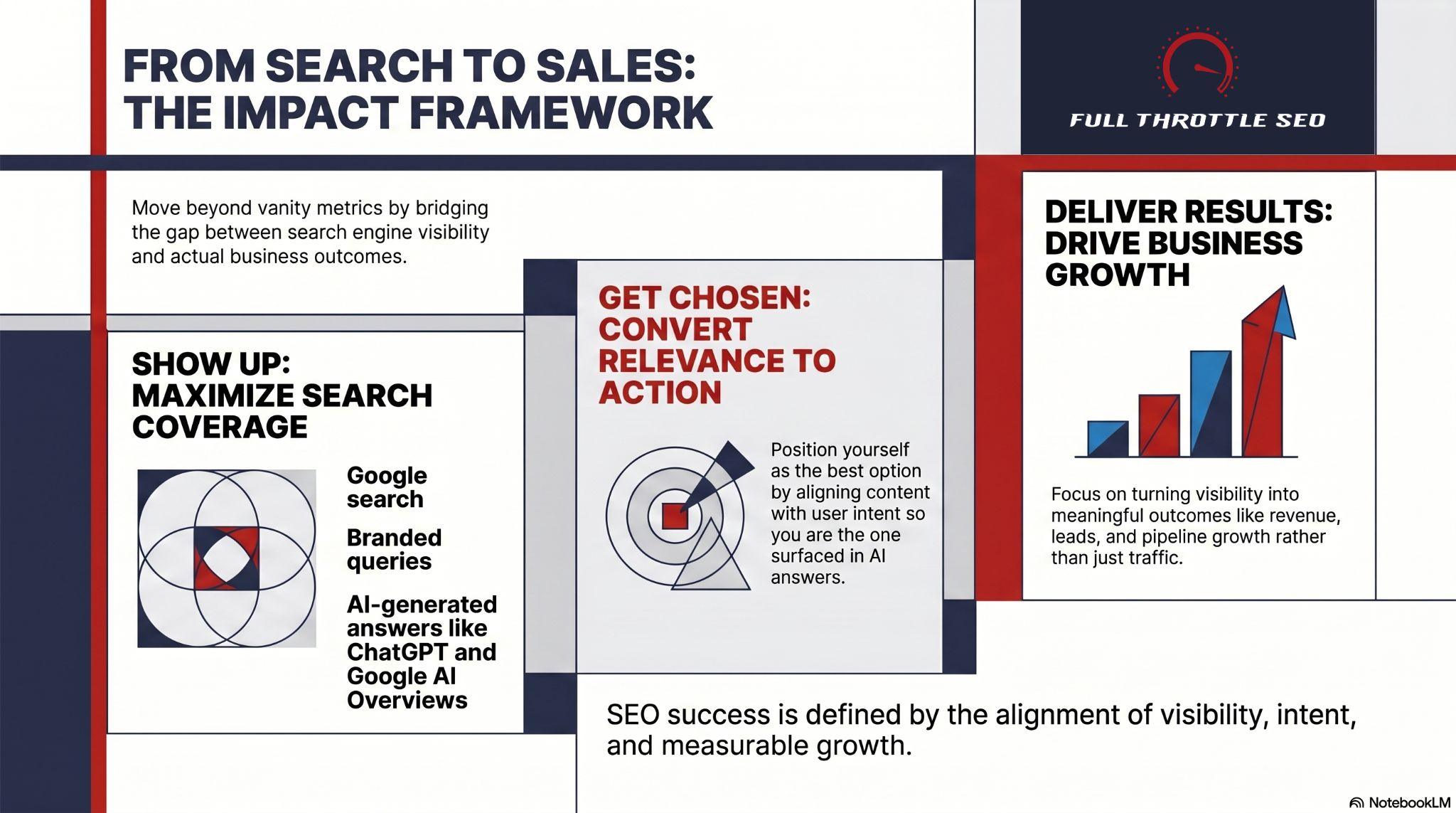
This is exactly why I use the Show Up. Get Chosen. Deliver Results. framework.
Not to replace SEO reporting, but to make it more meaningful and easier to interpret in a way that actually supports decision-making.
- Show Up focuses on visibility. Are you appearing where decisions are happening, across both traditional search and AI-driven experiences?
- Get Chosen looks at differentiation. When you show up, are you aligned with what your audience is actually looking for, or are you blending in with competitors?
- Deliver Results focuses on outcomes. Is that visibility turning into revenue, leads, or pipeline growth, or are you generating activity without measurable impact?
Looking at SEO analytics and reporting through these three areas makes it much easier to identify where things are working, where they’re not, and where to focus next.
What your monthly SEO reports should be giving you (and how to evaluate it)
This is where things shift from understanding the problem to evaluating whether your current SEO partner is actually helping you solve it.
Strong SEO reporting doesn’t just show metrics. It helps you make decisions.
If you’re working with an agency or consultant, your reporting should consistently help you understand:
- What specific actions were taken and why they were prioritized
- Which changes influenced rankings, traffic, or engagement
- How those changes are trending toward revenue or pipeline impact
- What didn’t work and what is being adjusted as a result
- What the next focus areas are based on current performance
If that level of clarity isn’t present, the issue isn’t necessarily effort. It’s how that effort is being translated into insight.
This is also where many agency relationships start to feel transactional instead of strategic. When reporting is centered around deliverables instead of outcomes, it becomes harder to see how your investment is contributing to growth.
A strong SEO partner doesn’t just send a report. They connect the work to the outcome and help you understand what to do next.
What to look for in more impactful SEO reporting
If you’re evaluating your current SEO reporting, there are a few clear indicators of whether it’s actually supporting your role as a decision-maker.
Impactful SEO reporting should:
- Tie major actions directly to measurable changes in performance
- Prioritize insights over volume of metrics
- Highlight both wins and missed opportunities
- Provide clear direction on what should happen next
- Translate performance into business impact, not just search metrics
SEO reporting tools and automated dashboards can absolutely support this process. They make it easier to gather and visualize data.
But they don’t replace interpretation.
The value doesn’t come from the dashboard itself. It comes from how that data is analyzed, explained, and used to guide strategy.
Where this leaves most teams (and what to do next)
Most of the time, the issue isn’t that SEO isn’t working.
It’s that there isn’t a clear line between what’s being done, what’s improving, and what’s actually driving revenue or pipeline. That gap makes it harder to make confident decisions, harder to advocate for budget, and harder to fully trust the direction things are going.
That’s where it’s worth taking a step back.
Not to review another report, but to evaluate whether your current strategy and execution are aligned with where the real opportunities are.
This is exactly why I put together the Revenue Gap Finder.
It’s not a performance report. It’s a structured way to evaluate your website and overall SEO approach against the gaps that typically hold businesses back. It helps identify where you’re missing opportunities across visibility, differentiation, and conversion, so you can focus on what actually needs to happen next.
If you’ve ever looked at a monthly report and felt like something was missing, even if you couldn’t quite explain what it was, this will help you put a clearer structure around that feeling.
Because once you can clearly see where the gaps are, you can start making decisions that actually move the business forward, whether that means adjusting your current strategy or rethinking how your SEO efforts are being supported.

J. “Ivy” Boyter is the founder of Full Throttle SEO, a Florida-based SEO consultancy. With nearly 15 years of digital marketing experience, she helps businesses turn search visibility into qualified leads and revenue, with a focus on ecommerce SEO, technical audits, and visibility in AI-powered search. Her approach connects SEO priorities to business goals, helping brands show up, get chosen, and deliver results.
Outside of work, Ivy competes in autocross and rallycross, wrangles kids and chickens, and writes heartfelt marriage and parenting advice.