
If you’ve been hearing that AI is replacing search, Google Analytics just gave us a much better way to reality-check that conversation.
GA4 has started rolling out a new AI Assistant channel in its default channel groupings, and I’m finally seeing it appear inside client accounts. That means traffic from certain AI tools is no longer buried quite as awkwardly inside referral traffic, direct traffic, or custom channel group workarounds.
According to Google, GA4 can now automatically assign the medium ai-assistant when the referrer matches a recognized AI assistant. Those visits are then grouped under a dedicated AI Assistant channel, with the campaign name showing as (ai-assistant). Google says this is designed to help businesses monitor clicks from generative AI tools, compare AI-driven traffic to traditional channels like organic search, and understand how AI assistants may be impacting business results.
That is a big deal.
Not because SEO is dead.
Because now we have more proof that it is not.
What Is the AI Assistant Channel in GA4?
The new AI Assistant channel is GA4’s way of categorizing traffic that comes from recognized AI assistant platforms.
Search Engine Journal reported that the feature began appearing around mid-May 2026, and that marketers who were previously using custom channel groups to track AI assistant traffic may be able to simplify some of that setup as the native channel becomes available.
So far, I’ve personally confirmed AI Assistant traffic from sources including:
- ChatGPT
- Gemini
- Perplexity
- Copilot
- Claude
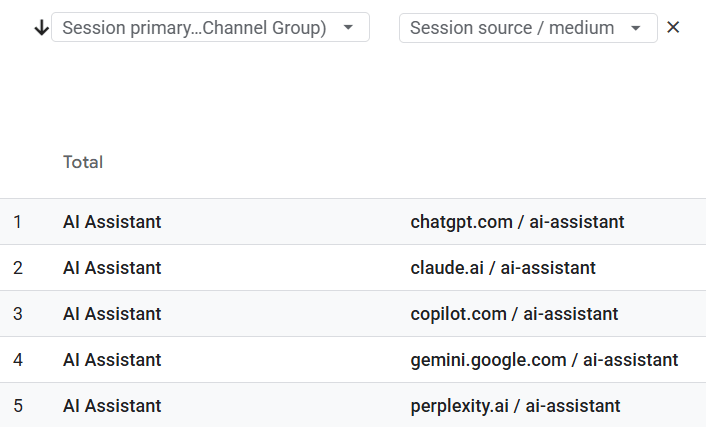
That does not mean GA4 will catch every AI-influenced visit. It also does not mean every AI mention turns into a website session. But it does give business owners and marketing teams a more useful place to start.
Before this, tracking AI traffic often required custom channel groups, regex rules, referral source digging, or a slightly unhinged spreadsheet habit.
No judgment. Some of us enjoy those.
But now, GA4 is starting to give AI traffic its own seat at the table.
Why This Matters for Business Owners and Marketing Managers
The AI Assistant channel matters because it helps answer a question more businesses are asking:
Are AI tools actually sending people to our website and are they converting?
That question is very different from:
Is AI changing how people discover brands?
Both matter. But they are not the same question.
AI assistants may influence discovery, research, comparison, and brand consideration long before someone clicks to your website. But in GA4, we are mostly looking at the measurable click.
That distinction is important because it keeps us from overreacting.
Yes, AI traffic is real.
Yes, people are using tools like ChatGPT, Gemini, Perplexity, Copilot, and Claude to find answers, compare options, and make decisions.
But based on the ecommerce data I’m seeing, AI Assistant traffic is still a very small piece of the measurable traffic and revenue picture.
What I Found Reviewing 18 GA4 Accounts
As a follow-up to my guide on SEO, GEO, and AEO, I reviewed GA4 screenshots from 18 ecommerce brands over the same 28-day period.
The brands will stay anonymous because the point is not to call out individual companies. The point is to look at what the data is actually showing.
And right now, the pattern is pretty clear:
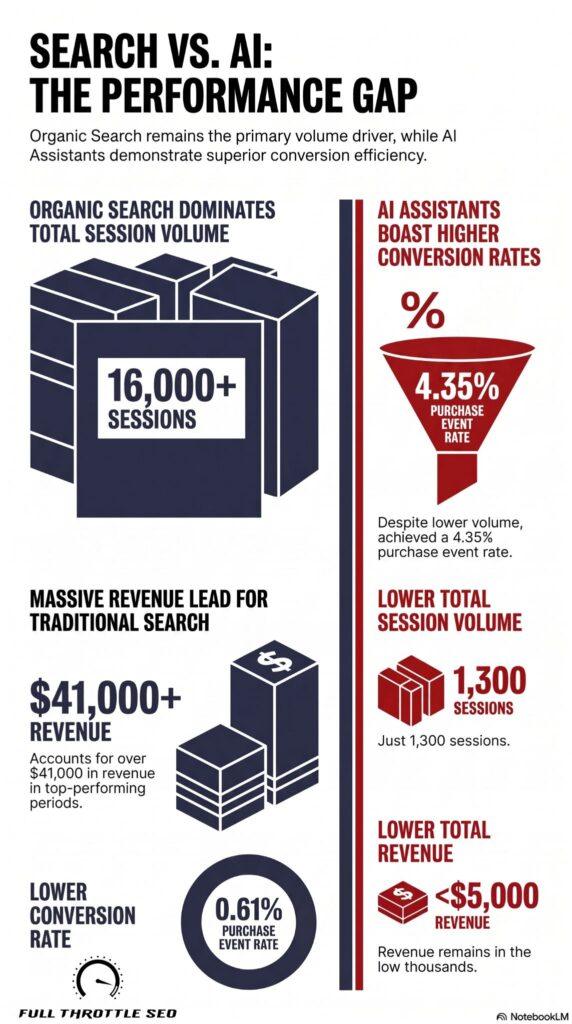
AI Assistant traffic is showing up, but Organic Search is still doing the heavy lifting.
In several accounts, AI Assistant traffic had interesting engagement or conversion behavior. In some cases, it converted at a higher rate than Organic Search.
But the volume gap was massive.
For example:
- One store saw more than 15,700 Organic Search sessions compared to just 49 AI Assistant sessions.
- Another saw more than 16,000 Organic Search sessions compared to 188 AI Assistant sessions.
- A third saw more than 10,500 Organic Search sessions compared to 165 AI Assistant sessions.
That is not a small difference.
That is the difference between a channel supporting business growth and a channel still proving its scale.
The Revenue Story Is Even More Important
Traffic matters, but revenue matters more.
Across the ecommerce accounts I reviewed, Organic Search continued to generate significantly more revenue than AI Assistant traffic.
A few examples from the data:
- Organic Search generated $14,869 compared to $950 from AI Assistant traffic.
- Organic Search generated $41,042 compared to $6,053 from AI Assistant traffic.
- Organic Search generated $16,133 compared to $899 from AI Assistant traffic.
That does not mean AI traffic is useless.
Actually, it means the opposite.
It means AI Assistant traffic is worth watching because people who do click from AI tools may be highly motivated. They may already be further along in the decision-making process. They may be using AI to narrow their options before taking action.
But it also means we need to be honest.
A high conversion rate from a tiny number of sessions does not replace the revenue scale of Organic Search.
A 10% conversion rate sounds exciting until you realize it came from a handful of visits.
A 5% conversion rate on thousands of qualified organic visitors is usually much more valuable to the business.
This is where a lot of the “SEO is dead” conversation starts to fall apart.
AI Traffic Is a Signal, Not a Replacement Strategy
The biggest mistake businesses can make right now is treating AI visibility like it replaces SEO.
It does not.
If anything, AI visibility is another reason SEO fundamentals matter.
AI tools still need information to understand your business. They still rely on content, structure, authority, brand mentions, product clarity, third-party references, and machine-readable signals. In many cases, the work that helps you show up in AI-driven discovery overlaps heavily with the work that helps you perform in traditional search.
That includes:
- Clear service and product pages
- Helpful content that answers real buyer questions
- Strong technical SEO
- Schema markup
- Internal linking
- Entity clarity
- Reviews and trust signals
- Consistent brand information across the web
- Content that demonstrates actual expertise
In other words, AI did not make SEO irrelevant.
It made weak SEO easier to expose.
What You Should Look at in GA4
Now that the AI Assistant channel is rolling out, business owners and in-house marketing managers should start watching it, but with context.
Do not just look at whether AI Assistant traffic exists.
Look at:
- Sessions from AI Assistant traffic
- Revenue or key events from AI Assistant traffic
- Session key event rate
- Average engagement time
- Landing pages receiving AI traffic
- Which AI sources are sending visitors
- How AI Assistant traffic compares to Organic Search, Direct, Paid Search, and Cross-network traffic
The comparison matters.
If AI Assistant traffic converts well but only sends 20 visits, that is useful information. But it is not a reason to gut your SEO budget.
If Organic Search is driving thousands of sessions and meaningful revenue, that is also useful information. And it should probably make you very cautious about chasing shiny objects at the expense of the channel already producing results.
Where This Fits Into SEO, GEO, and AEO
This is where I think the conversation needs to mature.
We do not need to argue about whether SEO, GEO, AEO, LLMO, or whatever acronym shows up next is the “real” strategy.
The practical answer is that businesses need to be findable, understandable, and trustworthy across more search environments than before.
Traditional Google Search still matters.
AI Overviews matter.
AI assistants matter.
Brand search matters.
Reviews matter.
Third-party mentions matter.
Direct traffic matters.
Your website still matters.
The channel mix is changing, but the job has not changed as much as people think.
Your audience still has questions.
Your content still needs to answer them.
Your website still needs to load, rank, convert, and clearly explain why someone should choose you.
And your brand still needs enough trust signals for both humans and machines to understand why you are a credible option.
What This Proves So Far
The addition of the AI Assistant channel in GA4 gives marketers something we badly needed: a clearer way to separate AI-referred traffic from the rest of the mess.
But the early data does not support the idea that SEO is dead.
It supports a much more practical conclusion:
AI search is growing, but Organic Search is still one of the strongest revenue engines most businesses have.
AI Assistant traffic deserves attention.
It deserves measurement.
It deserves a place in your reporting.
But it should not be treated like a replacement for the organic visibility that is still driving the majority of measurable traffic and revenue in many accounts.
So yes, check your GA4 account.
Look for the AI Assistant channel.
See which tools are sending traffic.
Watch the conversion behavior.
But please do not let LinkedIn hype convince you to abandon the search foundation that is still paying the bills.
SEO is not dead.
It is expanding.
And now, thanks to GA4, we can finally start proving that with better data.

J. “Ivy” Boyter is the founder of Full Throttle SEO, a Florida-based SEO consultancy. With nearly 15 years of digital marketing experience, she helps businesses turn search visibility into qualified leads and revenue, with a focus on ecommerce SEO, technical audits, and visibility in AI-powered search. Her approach connects SEO priorities to business goals, helping brands show up, get chosen, and deliver results.
Outside of work, Ivy competes in autocross and rallycross, wrangles kids and chickens, and writes heartfelt marriage and parenting advice.