
Most businesses invest in SEO because they want to be found by the right people, chosen over competitors, and see that visibility turn into leads, customers, and revenue. The problem is that many SEO strategies are still measured in ways that do not tell the full story.
Rankings matter. Traffic matters. Clicks matter. But if those numbers are not connected to actual business outcomes, it becomes hard to know whether your SEO is working or simply keeping everyone busy.
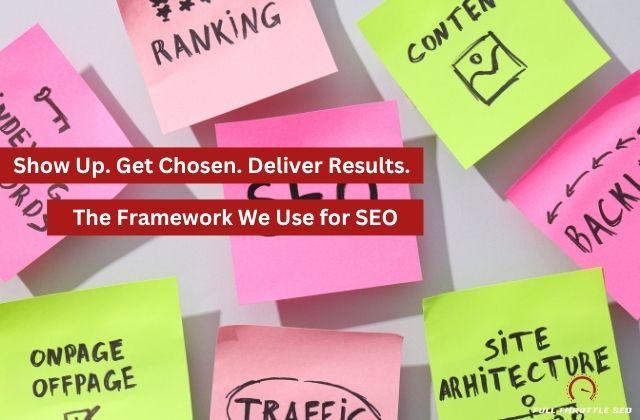
That is why I created the Show Up. Get Chosen. Deliver Results. framework™.
It is a practical way to evaluate whether your SEO strategy is doing what it should be doing:
Helping your business show up where your customers are searching.
Giving people a reason to choose you once they find you.
Turning that visibility into measurable results your business can actually use.
Why Traditional SEO Reporting Often Falls Short
A lot of SEO reporting focuses on movement like:
- Keyword rankings went up or down.
- Organic traffic increased or decreased.
- Impressions changed.
- Clicks changed.
Those numbers can be useful, but they do not always answer the bigger question:
Is this helping the business grow?
That is where many reports fall short.
A business may rank for more keywords but still not get better leads.
A website may earn more traffic but not see more form submissions, calls, booked appointments, or sales.
A page may show up in search results but fail to explain why someone should trust the business, contact the team, or buy the product.
And now that people are searching across more places, including Google, AI tools, local results, social platforms, and comparison-driven searches, visibility is no longer as simple as ranking on page one for a handful of keywords.
SEO needs to be evaluated by more than whether you showed up somewhere.
It needs to look at whether your business showed up in the right places, with the right message, for the right audience, and whether that visibility helped move people closer to action.
That is what this framework is designed to do.
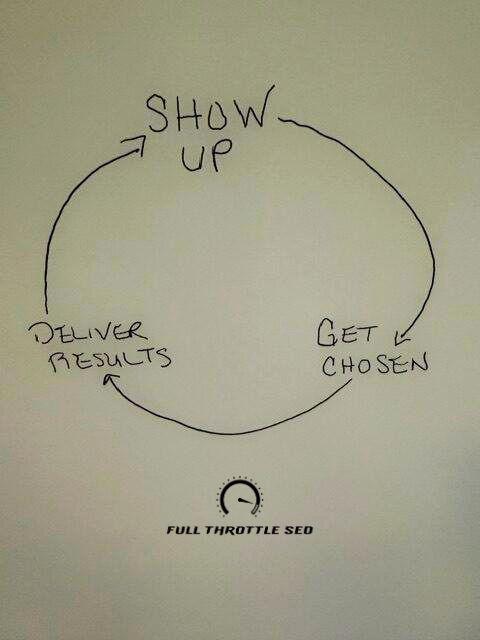
What the Show Up. Get Chosen. Deliver Results. Framework™ Means
The framework is built around three questions every SEO strategy should answer.
- Are you showing up where your customers are searching?
- Are you giving them a reason to choose you?
- Is your visibility creating measurable business results?
Each part matters. If one piece is missing, SEO can look active on paper but underperform where it matters most.
Show Up: Be Visible Where Your Customers Are Looking
The first step is visibility.
Your business needs to show up when potential customers are actively looking for answers, services, products, providers, comparisons, or solutions.
That may include traditional Google search, local map results, AI-generated answers, product category searches, YouTube, social search, industry directories, or other platforms where people research before making a decision.
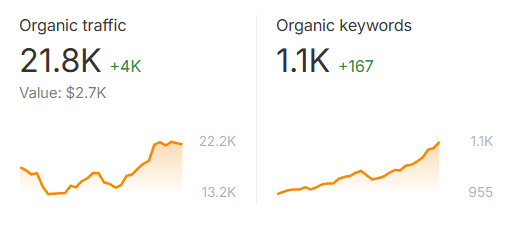
For years, SEO was often talked about as if the only goal was ranking on Google.
Google is still important. In many cases, it is still the primary driver of qualified organic traffic. But SEO has evolved into something bigger than traditional search rankings. It is increasingly about helping your business show up across the places people search, compare, and make decisions, which is why I often describe modern SEO as Search Everywhere Optimization.
The way people search is changing
Some people are comparing options in AI tools.
Some are asking Google more specific questions.
Some are looking for proof before they ever reach your website.
Some are searching your brand name after seeing you somewhere else.
Some are skipping broad informational searches and moving straight to high-intent comparison or purchase searches.
Showing up means understanding where your ideal customers are searching and making sure your business has a strong enough presence in those places.
That includes your website, but it may also include your Google Business Profile, review platforms, third-party mentions, structured data, content assets, case studies, product pages, service pages, and the overall clarity of your brand online.
A few questions to ask:
- Are your most important services, products, or categories easy for search engines and AI tools to understand?
- Are your key pages optimized around how your customers actually search?
- Are you visible for searches that indicate buying intent, not just general interest?
- Are you showing up in local, organic, branded, and AI-influenced search experiences?
- Can search engines clearly understand who you help, what you offer, and why it matters?
Showing up is the starting point.
But visibility alone is not enough.
Get Chosen: Give People a Reason to Trust You
Getting found is only part of the job.
Once someone finds your business, they still need to decide whether you are the right choice and this is where many SEO strategies lose momentum.
A page may rank, but the content may feel generic.
A product category may get traffic, but fail to explain what makes the products different.
A service page may describe what the business does, but not why someone should choose that provider over another option.
A website may attract visitors, but lack proof, reviews, examples, pricing context, clear next steps, or the trust signals people need before they take action.
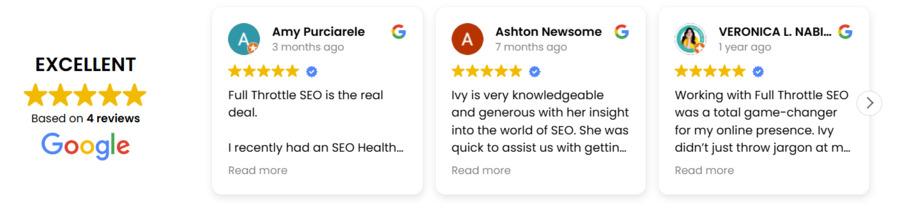
This is why the second part of the framework is Get Chosen… search visibility should lead to preference. That means your content and website experience need to help people feel confident about choosing you.
This can include:
- Clear positioning
- Strong service or product explanations
- Reviews and testimonials
- Case studies or proof of results
- Trust-building details about your process or experience
- Helpful comparison content
- Clear calls to action
- Easy-to-skim page structure
- Answers to common buyer questions
- Differentiators that are specific, not vague
For example, saying “we provide high-quality service” is not much of a differentiator. Most businesses say that.
But showing how your process works, who you are best suited for, what results you have helped create, what customers can expect, and what other customers say about their experience gives people something real to evaluate. That is why reviews and testimonials should not be treated as passive trust signals. For many businesses, they need to be part of an intentional review management strategy.
This matters for both traditional search and AI search.
AI tools, search engines, and potential customers all need clear signals about what your business does, who it serves, and why it is credible.
If your website is thin, vague, outdated, or too similar to every competitor, you make it harder for both search engines and people to understand why your business should be recommended or chosen.
A few questions to ask:
- Does each important page explain why someone should choose your business?
- Are your differentiators clear, specific, and believable?
- Do you have proof to support your claims?
- Is your content written for real buyers, not just search engines?
- Are the next steps clear for someone who is interested?
Getting chosen is where SEO starts to connect more directly to conversion.
You are not just trying to win visibility.
You are trying to earn trust.
Deliver Results: Connect SEO to Business Outcomes
The final part of the framework is where SEO needs to prove its value.
Visibility should not exist in a vacuum.
If your business is showing up and getting chosen, the next question is whether that activity is leading to measurable results.
As search becomes more fragmented, those results may not always show up in reporting as cleanly as they used to.
A potential customer may discover you through Google, compare you in an AI tool, read a third-party mention, see a press release, check reviews, and then come directly to your website later. In GA4, some of that activity may show up as direct traffic instead of organic search.
That does not mean SEO is not working.
It may mean your visibility is influencing the buyer journey in ways that are harder to track with a single source or session.
That is why it is important to look at more than one metric when evaluating SEO performance.

Meaningful results may include:
– Qualified leads
– Phone calls
– Form submissions
– Booked appointments
– Ecommerce revenue
– Assisted conversions
– Better local visibility
– Higher-quality organic traffic
– Stronger branded demand
– Increases in branded search queries
– Growth in direct traffic from people who already researched your business
– More useful reporting and decision-making
Not every SEO effort produces an immediate revenue spike. SEO takes time, and some work is designed to build the foundation for future growth.
But your strategy should still be connected to outcomes.
That means reporting should not stop at rankings and traffic. It should help answer questions like:
- What work was completed?
- Why was that work prioritized?
- What changed after the work was done?
- Are we attracting the right audience?
- Are visitors taking meaningful action?
- What pages or search themes are creating opportunities?
- What should we do next based on the data?
This is where many businesses get stuck.
- They receive reports full of numbers, but no clear interpretation.
- They see ranking movement, but do not know whether it matters.
- They see traffic changes, but do not know whether the traffic is valuable.
- They see SEO activity, but cannot connect it to sales conversations, lead quality, revenue, or strategic next steps.
Delivering results does not mean every month will be perfect.
Sometimes the data shows growth.
Sometimes it shows a problem.
Sometimes it reveals that a page is getting traffic but not converting.
Sometimes it shows that a service or product category needs stronger content, better internal links, improved calls to action, more proof, or a better technical foundation.
That is still useful.
Good SEO reporting should help you make better decisions, not just review what already happened.
How Businesses Can Use This Framework
Businesses can use the Show Up. Get Chosen. Deliver Results. framework™ to evaluate whether their current SEO strategy is helping them move closer to real growth.
Start by looking at your current SEO through the three parts of the framework.
1. Are You Showing Up?
Look at your visibility across the places that matter most for your audience.
This may include organic rankings, local rankings, branded searches, non-branded searches, AI search visibility, Google Business Profile performance, important service or product pages, and content that supports the buyer journey.
You are looking for visibility that has a realistic connection to your business goals.
Ranking for broad informational terms may be helpful in some cases, but it should not distract from the searches that are more likely to drive leads, sales, or meaningful brand discovery.
2. Are You Getting Chosen?
Review your highest-value pages from the perspective of a potential customer.
Ask:
- Is this page clear?
- Is it useful?
- Does it answer the questions someone would have before contacting us or buying?
- Does it explain why we are a strong choice?
- Does it include proof?
- Is the next step obvious?
This is where SEO, content, conversion, and brand positioning overlap.
A technically optimized page can still underperform if it does not help people make a decision.
3. Are You Delivering Results?
Look beyond surface-level metrics.
Traffic without context can be misleading.
Rankings without conversions can be frustrating.
Clicks without qualified leads may not move the business forward.
The goal is to understand how SEO is contributing to outcomes the business actually cares about.
That may mean tracking form submissions, calls, ecommerce revenue, booked appointments, assisted conversions, local actions, or other meaningful engagement points.
It may also mean watching for signals that your brand is becoming part of the decision-making process, such as increases in branded search queries, more direct traffic, stronger engagement from returning visitors, or more people searching for your business after first discovering you somewhere else.
In a fragmented search environment, the path from discovery to conversion is rarely as simple as “searched Google, clicked organic result, converted.”
It also means using the data to guide the next round of strategy.
If something is working, build on it.
If something is underperforming, investigate why.
If visibility is improving but leads are not, the issue may be content, trust, offer clarity, page experience, conversion paths, or audience fit.
The framework helps you avoid treating SEO as a checklist and start treating it as a growth system.
What This Looks Like in Practice
For an ecommerce brand, showing up may mean ranking for important category and product searches.
Getting chosen may mean improving category page content, product details, internal links, reviews, comparison content, and trust signals so buyers understand why those products are the right fit.
Delivering results may mean tracking organic revenue, conversion rate, and which pages or categories are creating the strongest opportunities.
For a local service business, showing up may mean improving visibility in Google Maps, organic search, and AI-influenced local results.
Getting chosen may mean strengthening service pages, reviews, testimonials, location relevance, FAQs, and calls to action.
Delivering results may mean tracking calls, form submissions, booked appointments, and lead quality.
For a B2B service provider, showing up may mean being visible for high-intent service searches, problem-aware queries, and branded research.
Getting chosen may mean creating stronger proof, clearer positioning, more helpful service pages, and content that supports decision-makers.
Delivering results may mean tracking qualified inquiries, consultation requests, assisted conversions, and whether organic search is supporting the sales pipeline.
The details change by business model, but the core questions stay the same.
Are you visible?
Are you trusted?
Is it producing meaningful results?
Why This Matters More as Search Changes
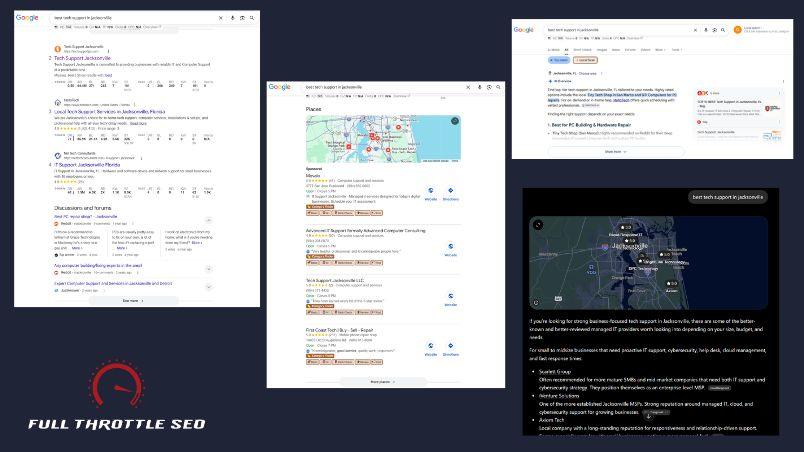
Search is no longer limited to a list of blue links.
People search in more places and expect better answers faster.
AI tools are changing how people discover, compare, and evaluate businesses.
Google continues to evolve how results are displayed.
Customers may interact with your brand several times before they ever submit a form, make a call, or place an order.
That also makes off-site visibility more important.
Backlinks, digital PR, press releases, third-party mentions, reviews, industry citations, and trusted references can all help reinforce what your business is known for. These signals have long mattered for traditional search engines like Google and Bing, but they are becoming increasingly important as AI tools and large language models look for reliable sources to mention, summarize, or cite.
That does not mean every business needs to chase press for the sake of press.
It means your business needs a credible footprint beyond its own website.
That means businesses need a clearer way to evaluate SEO than simply asking, “Did rankings go up?”
Rankings are still part of the picture.
But the bigger opportunity is understanding how your business appears across the search journey, how clearly it communicates value, and whether that visibility supports real business growth.
The businesses that win are not always the ones publishing the most content or chasing every new tactic.
They are often the ones that are clear, credible, findable, and easy to choose.
That is the point of the framework.
A Better Way to Evaluate SEO
SEO should help your business do more than appear in search results.
It should help the right people find you, understand why you are a strong choice, and take the next step.
That is what Show Up. Get Chosen. Deliver Results.™ is designed to evaluate.
If your current SEO strategy is only reporting rankings, traffic, and completed tasks, it may be missing the bigger picture.
A stronger strategy should help you answer:
– Where are we visible?
– Where are we missing opportunities?
– Are we earning branded searches, direct visits, or other signs that people are researching us before converting?
– Are we being mentioned, cited, or referenced on credible third-party sites?
– Why would someone choose us?
– What proof supports that decision?
– Which pages are helping drive leads or revenue?
– What should we improve next?
SEO is not just about getting seen.
It is about being found by the right people, giving them a reason to trust you, and turning that visibility into results your business can measure.
That is how you show up.
That is how you get chosen.
That is how SEO starts delivering results that actually matter.
At Full Throttle SEO, I help teams move toward scale and growth with SEO services designed for both traditional search and AI search. The goal is not just more visibility. It is more qualified leads, increased revenue, and a clearer strategy for turning search into a stronger growth channel.
If you want to evaluate whether your current SEO strategy is helping your business show up, get chosen, and deliver measurable results, contact me to book a free consultation.

J. “Ivy” Boyter is the founder of Full Throttle SEO, a Florida-based SEO consultancy. With nearly 15 years of digital marketing experience, she helps businesses turn search visibility into qualified leads and revenue, with a focus on ecommerce SEO, technical audits, and visibility in AI-powered search. Her approach connects SEO priorities to business goals, helping brands show up, get chosen, and deliver results.
Outside of work, Ivy competes in autocross and rallycross, wrangles kids and chickens, and writes heartfelt marriage and parenting advice.