
The right SEO partner should understand your business model, connect search visibility to leads or revenue, communicate clearly, and know how to prioritize the work most likely to create meaningful business impact.
When choosing an SEO partner, evaluate their strategic judgment, relevant experience, understanding of your customers and revenue model, approach to measurement, communication, knowledge of traditional and AI-driven search, and who will actually be responsible for your strategy.
If Jacksonville visibility matters to your business, local market experience can also be valuable. But location alone should not outweigh strategic expertise or fit.
Choosing an SEO partner should come down to more than who ranks first when you search “SEO company near me.”
That matters even more now because SEO is no longer limited to ten blue links on Google.
Your customers may discover your business through traditional search results, Google Maps, AI Overviews, ChatGPT, Perplexity, review sites, or several of those touchpoints before they ever contact you.
The question is no longer simply:
Who can improve our rankings?
It is:
Who can help us show up where our customers are searching, give them reasons to choose us, and turn that visibility into business results?
CONTENTS
What Should You Look for in an SEO Partner in Jacksonville?
A strong SEO partner should understand how your business makes money, identify the search opportunities most likely to support your goals, prioritize those opportunities based on potential business impact, and measure SEO against outcomes such as qualified leads, sales, or revenue rather than rankings alone.
When evaluating an SEO partner, focus on seven areas:
- Strategic judgment: Can they identify what deserves attention first and explain why?
- Relevant experience: Have they solved similar business or search challenges?
- Business understanding: Do they understand your customers, revenue model, priorities, and competitive environment?
- Measurement: Can they connect SEO performance to qualified leads, sales, revenue, or another meaningful business outcome?
- Communication: Can they explain the strategy clearly and keep your team informed?
- Modern search expertise: Do they understand both traditional SEO and how AI-driven search is changing discovery?
- Account responsibility: Do you know who will actually develop the strategy and perform or oversee the work?
The right mix depends on your business.
A Jacksonville home service company trying to generate more calls from Mandarin, San Marco, or the Beaches has very different SEO needs from a manufacturer headquartered in Jacksonville but selling nationally.
An ecommerce company has different priorities again.
Your SEO partner should understand those differences before recommending what you need.
1. Start With Your Business Goals, Not an SEO Package
One of the first things I would look for in an SEO partner is whether they start by trying to understand the business.
- What are you actually trying to accomplish?
- Maybe you need more qualified leads.
- Maybe organic revenue has stalled while paid acquisition costs keep climbing.
- Maybe your company is expanding into a new market.
- Maybe you already have an internal marketing team, but no one on the team has the SEO depth or bandwidth to confidently decide what deserves attention first.
Those situations require different strategies.
SEO can involve technical improvements, content, internal linking, local optimization, digital PR, authority building, structured data, conversion improvements and plenty of other tactics.
A good SEO strategy is not a list of deliverables. It is a prioritized plan for deciding which search opportunities are most likely to support the business goals and which deserve time and budget first.
Technical fixes, content, links, local optimization, structured data, and conversion improvements may all have a place. The strategic work is deciding which of those opportunities matter for this business, in this competitive environment, right now.
That is why I would be cautious about any provider prescribing a fixed number of blog posts, backlinks, or technical tasks before they understand how your business makes money.
The value of an experienced SEO partner is not simply knowing which SEO tactics exist. It is knowing which opportunities are likely to matter, which can wait, and which are not worth spending the client’s budget on yet.
What should we do first?
What can wait?
What is likely to make the biggest difference?
And what sounds like a good SEO idea but probably is not worth your budget right now?
Questions to ask a potential SEO partner
Ask:
- What would you want to understand about our business before creating a strategy?
- How do you decide what to prioritize?
- How would our business model affect your recommendations?
- What would you consider a meaningful SEO result for a company like ours?
Their answers should tell you quite a bit.
2. Look for an SEO Strategy That Connects to Revenue
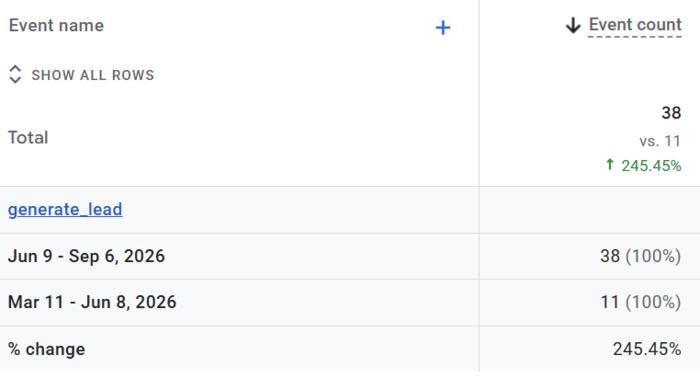
SEO performance should be evaluated against the business outcome the company is trying to create, whether that is qualified leads, appointments, ecommerce revenue, pipeline contribution, or another measurable goal.
In client reporting, I’ve seen organic traffic growth look impressive until we compared it with landing-page conversions, lead quality, or ecommerce revenue. That’s why I rarely treat traffic growth by itself as evidence that SEO is working.
Some of the strongest results I’ve seen in client campaigns were not simply increases in traffic. They were increases in the outcomes the business actually cared about, including organic revenue and qualified lead generation.
Rankings matter. Traffic matters. Visibility matters. But the real question is what happened because of that visibility.
SEO performance should ultimately be evaluated against the business outcome the company is trying to create, whether that is qualified leads, appointments, ecommerce revenue, pipeline contribution, or another measurable goal.
If organic traffic increases 40% but none of those visitors become customers, you have not necessarily created a business win.
The metrics that matter depend on the type of business.
For a Jacksonville service business, that may include:
- Qualified phone calls
- Form submissions
- Appointments
- Consultations
- Store visits
For ecommerce, it could include:
- Organic revenue
- Product discovery
- Conversion rate
- Assisted conversions
- Customer acquisition
For B2B companies with longer sales cycles, lead quality and pipeline contribution may matter more than last-click revenue.
A strong SEO partner should understand the distinction between SEO activity metrics and business outcome metrics.
They should also be willing to discuss measurement early.
That might mean using Google Search Console, GA4, call tracking, ecommerce reporting, CRM data or other systems to understand what happens after someone finds you.
Be cautious when every case study or report focuses on traffic increases without explaining what happened next.
At Full Throttle SEO, this is one reason I come back so often to:
Show Up. Get Chosen. Deliver Results.
Showing up is only the first part of the equation.
3. Make Sure They Understand How Search Is Changing
Your SEO partner still needs to understand traditional Google Search exceptionally well.
But that cannot be the end of the conversation anymore.
Consumers can now encounter businesses through Google Search, AI Overviews, AI Mode, ChatGPT, Perplexity and other AI-assisted research experiences.
When evaluating an SEO partner for AI search, look for someone who understands how AI-driven discovery fits into the broader search strategy rather than treating it as a collection of separate “GEO hacks.”
Businesses still need crawlable websites, clear and useful content, demonstrated expertise, strong brand signals, credible third-party validation, and information that search systems can understand and retrieve.
What has changed is where and how that information may surface. Customers can now encounter brands through traditional search results, AI Overviews, AI Mode, ChatGPT, Perplexity, and other AI-assisted research experiences.
A strong SEO partner should understand those changes without pretending the fundamentals no longer matter.
That does not mean you need someone selling mysterious “GEO hacks.”
In fact, Google’s current guidance makes a point that I strongly agree with: optimizing for generative AI search experiences is still fundamentally SEO. Google specifically encourages businesses evaluating AEO or GEO services to scrutinize third-party recommendations rather than assuming a new acronym requires an entirely separate playbook.
The fundamentals still matter.
Your business needs to be understandable.
Your website needs to be crawlable.
Your content needs to be useful and specific.
Your expertise needs to be evident.
Your brand needs credible signals across the web.
And your content needs to offer something worth retrieving, referencing or recommending instead of simply repeating what is already everywhere else.
Ask an SEO partner how they approach AI search visibility
Listen for answers that include ideas like:
- Answering specific customer questions clearly
- Creating genuinely useful, non-commodity content
- Demonstrating first-hand expertise and experience
- Strengthening brand and entity consistency
- Building authority beyond your own website
- Improving technical accessibility
- Using structured data appropriately
- Understanding how search intent changes throughout the buying journey
Be more skeptical if the answer revolves around guarantees, secret tactics or a promise that they can “get you cited by ChatGPT.”
Nobody controls that.
An SEO partner cannot guarantee citations in ChatGPT, Perplexity, Gemini, or Google’s AI experiences. What they can do is improve the technical, content, authority, and trust signals that make a brand easier for search systems and customers to discover, understand, and evaluate.
That is a much more defensible promise.
4. Ask Who Will Actually Work on Your SEO
When evaluating an SEO agency or consultant, find out who will actually be responsible for strategy, technical review, content decisions, reporting, and day-to-day communication. The experience of the person selling the engagement may not reflect the experience of the person managing the account.
This gets overlooked far too often.
The person leading the sales call may not be the person reviewing your website, developing your strategy or making recommendations six months later.
That is not automatically bad.
Large SEO agencies can provide extensive resources, specialized departments and well-developed processes.
But you should understand what you are buying.
Ask:
- Who is responsible for our SEO strategy?
- Who will we communicate with regularly?
- Who reviews technical findings?
- Who approves content recommendations?
- How experienced is the strategist assigned to us?
- How many accounts does that person manage?
- Is any of the work outsourced?
- If so, how is quality controlled?
This is where the difference between an SEO vendor and an SEO partner often becomes obvious.
Some businesses genuinely need a large agency.
Others need direct access to a senior strategist who understands the broader marketing picture and stays close enough to the account to notice when priorities change.
Neither structure is necessarily better, but it’s helpful to know which one you are getting.
5. Look for Judgment, Not Just Deliverables
SEO deliverables are easy to put into a proposal.
Technical audits. Keyword research. Content briefs. Backlinks. Reporting.
The harder skill is judgment.
- Does the SEO partner know which problems actually deserve attention?
- Can they distinguish an urgent issue from something that is technically imperfect but unlikely to affect the business?
- Can they tell you when improving three existing commercial pages is a better investment than publishing ten new articles?
- Can they tell you when a keyword has search volume but little value to your actual buyers?
You are not hiring an SEO partner to generate the longest possible list of tasks. You are hiring them to help decide what is worth doing.
More content will not necessarily fix an ecommerce website with serious indexation problems.
Backlinks will not rescue a page that fundamentally misunderstands search intent.
Increasing traffic to a poorly positioned service page may simply give you more visitors who leave without becoming leads.
Sometimes the best SEO recommendation sounds like:
“Yes, that is an issue, but it isn’t the first thing I would spend money fixing.”
Or:
“That keyword has search volume, but the people searching it are not your buyers.”
Or:
“We could publish ten new articles, but improving these three commercial pages is much more likely to support revenue first.”
That is strategy.
And frankly, that is one of the biggest things I would look for when choosing an SEO partner.
You do not need someone who can identify 147 SEO issues.
Tools can identify issues. Your SEO partner needs to filter out the noise, tell you which issues actually matter, and explain why.
6. Consider Relevant Experience Without Demanding an Exact Industry Match
Relevant SEO experience matters, but I would evaluate experience based on the problems a strategist has solved, not simply whether they have worked with a company in your exact industry.
SEO strategy changes significantly across business models. An ecommerce brand with thousands of product pages presents different technical, content, and revenue challenges from a local healthcare provider or a manufacturer selling nationally.
What I would want to know is whether the strategist can understand your customer journey, competitive landscape, search intent, revenue drivers, and the constraints your marketing team is actually working with.
If you operate in ecommerce, healthcare, professional services, manufacturing or another industry with specific search challenges, it is reasonable to ask whether an SEO provider has dealt with similar situations.
But I would not make “Have you worked with a company exactly like mine?” your only test.
An experienced strategist should be able to learn a business. In fact, this is one of the parts I love most about being in SEO … I’ve had the pleasure of working with various businesses and am constantly learning new things.
More important questions include:
- Can they understand the customer?
- Can they understand how you make money?
- Can they analyze your competitive environment?
- Can they recognize different search intent?
- Can they explain how they approached similar business challenges?
Google also recommends asking prospective SEO providers about previous work, industry experience, geographic experience, expected results, measurement and communication.
If Jacksonville (or any other city/region) visibility is important to you, local market experience can absolutely help.
But simply having an office in Jacksonville does not automatically make someone the best Jacksonville SEO partner.
The strategy still has to be there.
7. Pay Attention to the Questions They Ask You
One of the easiest ways to evaluate an SEO provider is to stop listening to their pitch for a minute and pay attention to what they ask you.
Do they ask which products or services are most profitable?
Which leads tend to become your best customers?
Which competitors actually win business from you?
What has already been tried?
What your sales cycle looks like?
What your internal marketing team can realistically implement?
Whether your website converts well once visitors arrive?
Whether certain services are more important to grow than others?
Those questions matter because strong SEO requires context.
A provider cannot meaningfully prioritize opportunities without understanding what matters to the business.
If the entire discovery call feels like someone collecting just enough information to decide which package to sell you, pay attention to that.
Your SEO strategy should fit your business.
Your business should not have to fit the SEO package.
One of the best ways to evaluate an SEO partner is to pay attention to what they want to understand before they recommend anything.
If they ask about your highest-value products or services, lead quality, sales cycle, competitive environment, internal resources, previous marketing efforts, and growth priorities, they are gathering the context needed to make strategic decisions.
If they mainly ask enough questions to determine which predefined package to sell you, that tells you something too.
The questions an SEO provider asks during discovery often reveal how they think before the proposal ever arrives.
8. Evaluate Communication Before You Sign
SEO tends to cross departmental lines.
Your SEO may need to communicate with writers, developers, marketing managers, ecommerce teams, executives or outside agencies.
That means communication is not a soft skill.
It directly affects whether SEO recommendations actually get implemented.
A good SEO partner should be able to explain:
What are we doing?
Why are we doing it?
What happened?
What does the data tell us?
What should happen next?
Without forcing you to translate a wall of SEO jargon first.
You should leave conversations with your SEO partner feeling clearer about the problem, the strategy and what happens next, not more confused than when the conversation started. Just as importantly, you should feel like they understand where your business is trying to go, not simply which SEO services they want to sell you.
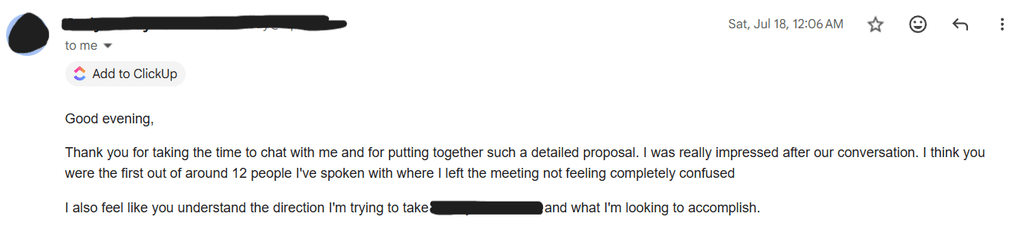
That is something I care about a lot in my own client relationships. One prospective client told me after speaking with roughly a dozen SEO providers that ours was the first conversation they left without feeling completely confused, and that they felt I understood the direction they were trying to take the business.
Good reporting should do the same thing.
A monthly dashboard full of rankings, impressions and charts is not automatically useful reporting.
Good SEO reporting should explain what changed, why it likely changed, how the change relates to business goals, what work was completed, and what should be prioritized next.
You should be able to understand:
- What improved
- What declined
- What likely caused the change
- How those changes connect to the business
- What the SEO team worked on
- What is being prioritized next
- What they need from your team
If you regularly finish an SEO report still wondering, “But what did they actually do this month?”, something is missing.
9. Be Wary of SEO Guarantees
An SEO partner can influence your visibility. They cannot control the search results.
Be skeptical of anyone guaranteeing a specific Google ranking or promising that your business will be cited by ChatGPT, Perplexity, Gemini, or Google’s AI experiences.
Those outcomes depend on search platforms, algorithms, competition, query context, user intent, and other factors outside an SEO provider’s control.
A credible partner should instead explain what they can influence: technical accessibility, content quality, relevance, authority, brand signals, local visibility, user experience, and your ability to be discovered and evaluated across search experiences.
Competitors change.
Search intent shifts.
Algorithms change.
Google controls its own search results.
The same principle now applies to AI-driven search.
No SEO provider controls whether ChatGPT, Gemini, Perplexity or Google’s AI experiences mention a specific company in response to a particular prompt.
Someone can absolutely improve your likelihood of being discovered, understood and considered.
They can improve your content.
Strengthen your authority.
Fix technical problems.
Clarify your expertise.
Improve your local presence.
Strengthen third-party trust signals.
Monitor how your visibility evolves.
But certainty should make you skeptical.
Especially when the system being discussed is one the SEO provider does not control.
10. Evaluate the Relationship, Not Just the Proposal
SEO is an ongoing strategic discipline, so the quality of the working relationship matters almost as much as the original proposal.
Even if the relationship starts with an audit, someone still has to prioritize the recommendations, implement changes, measure what happened and adapt.
Competitors will change.
Your business priorities will change.
Search behavior will change.
Google will change.
Your website will change.
That makes the relationship itself important.
Do you feel comfortable asking questions?
Will the SEO provider challenge an idea when they believe it is the wrong move?
Will they tell you when something is technically an SEO problem but probably not worth spending money on yet?
Can they collaborate with your internal marketing team?
Do they understand enough of the broader business to recognize when SEO should support another initiative rather than operate in its own little silo?
For marketing teams in particular, the best SEO relationships often begin to feel less like managing another vendor and more like adding specialized expertise to the team.
That is a very different relationship.
Red Flags When Choosing an SEO Company in Jacksonville (or any other location)
Some warning signs are obvious. Others sound attractive until you understand what is behind them.
Be cautious if a prospective SEO partner:
- Guarantees specific Google rankings
- Guarantees placement or citations in AI search
- Focuses heavily on traffic without asking about conversions or revenue
- Recommends the same package before understanding your business
- Cannot explain who will actually perform the work
- Uses jargon instead of explaining the strategy
- Cannot show evidence of previous results or strategic thinking
- Recommends fixing every issue an automated SEO tool identifies
- Equates the number of deliverables completed with success
- Sells AEO or GEO as a completely separate discipline without explaining how it connects to core SEO, content, authority, technical accessibility, and search visibility
- Claims to have proprietary access or a special relationship with Google
- Pushes questionable link schemes or shortcuts
Google has continued to reinforce its guidance around evaluating third-party SEO advice and tools, including the importance of scrutinizing recommendations rather than assuming an SEO tool or service has Google’s endorsement.
How Much Does SEO Cost in Jacksonville?
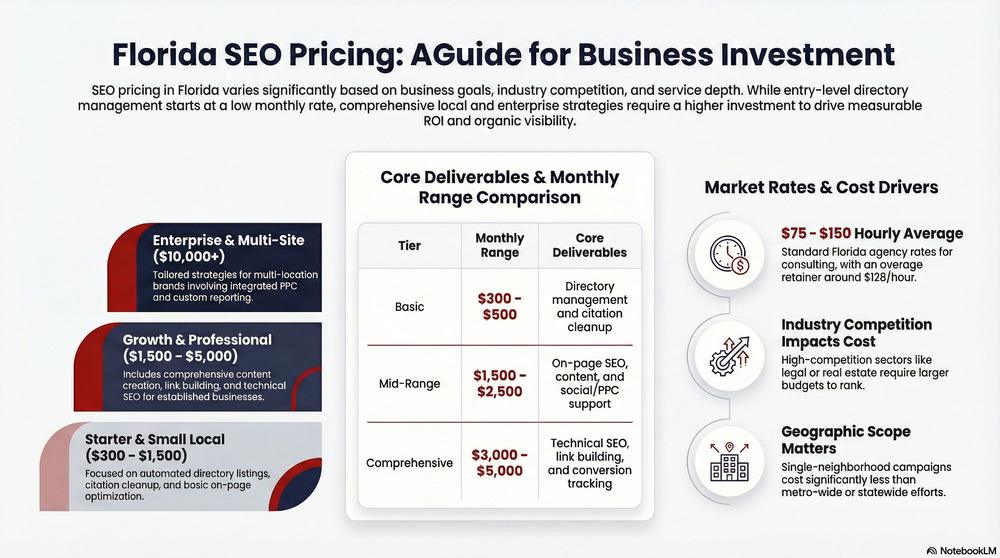
SEO pricing in Jacksonville varies based on website size, competition, technical complexity, geographic reach, content needs, ecommerce or local SEO requirements, internal resources, and how much strategy and implementation the provider includes. Price alone does not indicate the quality or fit of an SEO partner.
Pricing depends heavily on what the business actually needs.
A small local service website competing within a limited geographic area requires a different level of effort than a 10,000-product ecommerce store or a B2B company competing nationally.
Pricing can be affected by:
- Website size
- Technical complexity
- Competition
- Geographic reach
- Existing authority
- Content needs
- Local SEO requirements
- Ecommerce complexity
- Internal marketing resources
- Development support
- How much implementation is included
Instead of comparing SEO proposals based only on the monthly price, compare what you are actually getting.
How senior is the person making strategic decisions?
How customized is the strategy?
How much execution is included?
How accessible is the team?
How will success be measured?
Are they solving the problems your business actually has?
Cheap SEO gets expensive when you spend 12 months funding work that was never likely to move the business forward.
At the same time, the largest or most expensive agency is not automatically the best choice.
Fit matters more than price alone.
Do You Need a Jacksonville SEO Company?
A Jacksonville business does not necessarily need to hire a Jacksonville SEO company (and you don’t have to hire an SEO company local to you). Local experience can be valuable when the business depends heavily on Northeast Florida customers, but strategic expertise matters more when the company serves regional, national, or ecommerce markets.
If your customers are primarily local, working with an SEO partner who understands Jacksonville and Northeast Florida can be valuable.
Local competition changes neighborhood by neighborhood.
A business trying to reach customers in Mandarin may face a different search landscape from one focused on Ponte Vedra, Jacksonville Beach, Riverside, Orange Park or St. Johns.
Local SEO also involves signals beyond the website, including your Google Business Profile, reviews, local citations, geographic relevance and local authority.
But many Jacksonville companies do not operate exclusively in Jacksonville.
A manufacturer may be based here but sell nationwide.
An ecommerce company may have no reason to target Jacksonville searches at all.
A professional services firm may serve Florida statewide.
In those situations, hiring someone simply because they are local should not outweigh strategic expertise.
Being able to meet someone for coffee is nice.
Being able to trust their judgment with your marketing budget is more important.
| What to evaluate | Strong SEO partner | Warning sign |
|---|---|---|
| Strategy | Learns the business before prescribing work | Starts with a predefined package |
| Prioritization | Explains what matters now and what can wait | Treats every SEO issue as equally urgent |
| Measurement | Connects SEO to leads, sales or revenue | Reports mainly rankings and traffic |
| Experience | Explains problems solved and lessons learned | Relies mainly on years in business |
| Communication | Makes the strategy understandable | Hides behind jargon |
| AI search | Connects AI visibility to strong SEO fundamentals | Promises GEO hacks or guaranteed citations |
| Accountability | Makes it clear who owns strategy and execution | Senior people sell, junior teams quietly execute |
Questions to Ask Before Hiring an SEO Partner
Before signing an SEO agreement, ask questions that reveal how the provider actually thinks:
- How will you learn our business before developing the strategy?
- What would you prioritize during the first few months?
- How do you decide which SEO opportunities deserve our budget?
- Which metrics would you use to judge whether our SEO is working?
- How would you connect SEO to leads, sales or revenue?
- How do you approach local SEO if Jacksonville visibility matters to us?
- How do you approach AI Overviews and AI search platforms?
- What can you realistically influence, and what can you not guarantee?
- Who will be responsible for our strategy?
- Who will actually perform the work?
- How often will we communicate?
- What will your reporting help us understand?
- Can you show examples of businesses where you solved similar problems?
- What would you need from our internal team?
- What is an example of an SEO tactic you might tell us not to spend money on?
I particularly like that last question.
One sign of a strategic SEO partner is a willingness to tell you when an opportunity is not worth your budget yet.
Choosing the Right Jacksonville SEO Partner Comes Down to Fit
The right SEO partner is the one that best understands your business, can identify the search opportunities most likely to matter, communicates the strategy clearly, and connects the work to meaningful business outcomes.
That may be a large agency, a boutique consultancy, or an independent senior strategist.
Size is not the deciding factor. Neither is price, proximity, the number of deliverables in the proposal, or who happens to rank first when you search for an SEO company.
The better question is whether you trust the people responsible for your SEO to make good decisions with your marketing budget.
The right Jacksonville SEO partner should build strategy around the business rather than forcing the business into a predefined SEO package. The work should improve visibility where customers search, strengthen the reasons customers choose the business, and connect SEO activity to meaningful business outcomes.
Show Up. Get Chosen. Deliver Results.
That is a much better standard for evaluating an SEO partnership than rankings alone.
Why Businesses Choose Full Throttle SEO as Their Jacksonville SEO Partner
Full Throttle SEO is a Jacksonville-based, founder-led boutique SEO consultancy built for businesses that want senior-level SEO expertise without getting lost inside a large agency.
My experience includes SEO strategy for ecommerce brands, manufacturers, healthcare organizations, professional services firms, and local businesses. That work has included technical audits, content strategy, ecommerce optimization, local search, authority building, and programs tied to measurable growth in leads and organic revenue.
Recent ecommerce work has contributed to substantial organic revenue growth, including triple-digit gains for established brands.
Clients work directly with me, Ivy Boyter, on strategy, prioritization and recommendations.
I intentionally maintain a limited client roster because good SEO requires context. I want to understand what you sell, how customers choose you, where revenue comes from, what your internal team can handle and which opportunities are actually worth pursuing.
Depending on the business, that may include traditional SEO, technical optimization, local search, ecommerce SEO, content strategy, authority building or improving visibility across AI-driven search experiences.
For internal marketing teams, I often function as an extension of the team, bringing deeper SEO expertise and additional execution bandwidth.
For business owners, my role is often to make SEO less mysterious and help them understand where their time and marketing budget are most likely to produce an impact.
The goal is never to complete the most SEO tasks.
It is to identify the right ones.
If you’re evaluating SEO partners in Jacksonville and want to better understand what your business actually needs, talk with Full Throttle SEO about your current visibility and growth goals.

J. “Ivy” Boyter is the founder of Full Throttle SEO, a Florida-based SEO consultancy. With nearly 15 years of digital marketing experience, she helps businesses turn search visibility into qualified leads and revenue, with a focus on ecommerce SEO, technical audits, and visibility in AI-powered search. Her approach connects SEO priorities to business goals, helping brands show up, get chosen, and deliver results.
Outside of work, Ivy competes in autocross and rallycross, wrangles kids and chickens, and writes heartfelt marriage and parenting advice.