
You’re ready to invest in SEO. You want more qualified leads, more ecommerce sales, or stronger visibility for the services that matter most to your business.
But before signing an agreement, there are two questions worth asking: Is my website ready for SEO? And is my business ready for what happens when it works?
Your website does not need perfect content, flawless speed scores, or every SEO issue resolved before you hire someone. Improving those things may be part of the work.
What you do need is a practical path to make changes, a clear business goal, realistic expectations, and the capacity to serve the customers you want to attract.
Is My Website Ready for SEO?
A website is ready to begin SEO work when your team can access and improve it, address barriers to search visibility, and give prospective customers a useful path toward an inquiry or purchase.
That is different from being fully optimized. Missing service pages, weak product descriptions, or incomplete tracking may be reasons to bring in an SEO partner.
A website that nobody can update presents a different problem.
Can You Access and Expand Your Website?
I have turned away prospective projects because the business did not have access to manage its website. In other cases, the content management system did not support the updates or additional pages the strategy required. The following is actual communication I had with a prospect after a discovery call and analysis of platform/content ownership:

It is difficult to move an SEO strategy forward when you cannot change the website.
Before committing to ongoing work, establish:
- Who controls the website, domain, and hosting accounts.
- Whether you can edit page content, titles, navigation, and internal links.
- Whether the platform supports new service, category, product, or resource pages.
- Who can handle technical changes beyond your marketing team’s access.
- Whether development support is included in the proposal or needs a separate budget.
You do not need to make every change yourself. You need someone authorized and able to implement the work.
If access is missing or the platform has serious limitations, resolve that barrier or agree on a workable development plan before paying for an ongoing campaign.
Can Search Engines Access Your Important Pages?
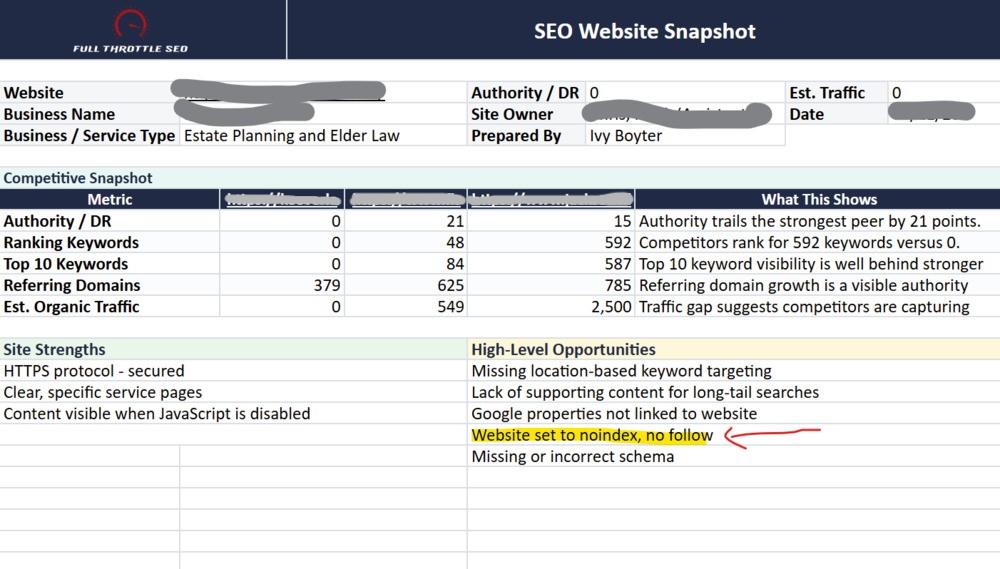
An SEO partner should check whether search engines can crawl and index the pages you want customers to find.
A website can look polished while important service or category pages remain excluded from search. Conversely, a site can have technical imperfections and still provide a workable foundation for improvement.
Google’s SEO Starter Guide explains how access, useful content, links, and logical organization help search engines discover and understand pages.
A technical SEO audit can help identify what is blocking progress and which fixes deserve attention first. The value is in understanding the impact of the findings and having a plan to act on them.
Does Your Website Help Customers Choose You?
Being found is only part of the job. Your website also needs to explain why the right customer should take the next step.
Can someone understand who you help, which problems you solve, and what makes your offer relevant to them? Can they find evidence that supports their decision? Does the contact form, booking process, or checkout actually work on a phone?
For a service business, that might mean clearly defined services, useful answers, relevant experience, and a straightforward inquiry process. For an ecommerce brand, it might mean informative category pages, product specifications, compatibility information, and clear shipping or return policies.
More traffic cannot compensate for an offer people do not understand. Messaging and conversion improvements should be part of the conversation before the campaign starts.
Are Your Goals, Budget, and Expectations Aligned?
“I want more traffic” gives an SEO partner very little direction.
A more useful goal identifies the business outcome: qualified inquiries for a priority service, organic sales in a profitable product category, or stronger visibility in a market you can actually serve.
That context helps determine which pages and opportunities deserve resources.
Your budget also needs to support more than the initial assessment. Ask what the proposed investment covers, what implementation costs sit outside it, and what your team will need to contribute. Content review, development work, and internal approvals all require time or money.
Plan for Progress Without Assuming a Fixed Deadline
Unrealistic expectations can undermine an otherwise sensible SEO investment, especially for a newly launched business.
In my experience, some new businesses can take eight to twelve months to begin seeing meaningful organic traffic. That is a planning consideration, not a standard deadline or a promised outcome. Existing visibility, competition, website quality, and the ability to implement changes all affect the path forward.
Traffic also does not automatically become leads or revenue. If your messaging does not connect customer pain points to a relevant solution, people may visit without taking action.
Ask a prospective SEO partner how they will establish a baseline, assess progress, and connect search performance to business outcomes. Early work may resolve obstacles or improve visibility before it contributes to sales.
If the business needs revenue immediately, discuss how SEO fits within the broader marketing plan rather than expecting it to carry that responsibility alone.
Is Your Business Ready to Scale?
I have also had clients stop working with me because they could not take on the additional work coming in from their SEO efforts.
The campaign was generating opportunities. The business did not have the capacity to serve them.
If customer service slips, responses slow down, or fulfillment becomes unreliable, more demand can create problems that extend beyond marketing.
Before pursuing growth, ask:
- Who responds to new inquiries, and who covers when that person is unavailable?
- Can your team qualify leads and follow up consistently?
- Do staffing, inventory, scheduling, or fulfillment limit what you can accept?
- Which services or products can you grow profitably?
- What would need to change if demand increased?
Being ready to scale does not mean chasing unlimited volume. You might want a better mix of customers, stronger margins, or more predictable demand. An SEO strategy should reflect those priorities and your capacity.
When a Business Consultant Can Help
Sometimes the next step involves operations as well as marketing.
If every decision depends on the owner, responsibilities are unclear, or existing demand already strains the team, a business consultant may help address those bottlenecks before or alongside a larger SEO investment.
For example, INTENT Strategy’s High-Definition Management brings leadership, operations, and customer growth into a coordinated approach. Its work includes clarifying roles, designing processes, and helping teams put those systems into practice.
That kind of support addresses a different need from SEO. Search strategy can help generate relevant demand; operational planning can help the business respond to it sustainably.
Should You Hire for SEO, AEO, or GEO?
You may hear answer engine optimization, or AEO, and generative engine optimization, or GEO, presented as reasons to replace SEO with an entirely new service.
It is reasonable to ask how a prospective partner addresses AI search. It is equally reasonable to expect a clear explanation of what they will actually do.
Google’s guidance on AI features says that existing SEO best practices remain relevant for AI Overviews and AI Mode. There are no additional technical requirements or special optimizations necessary. To qualify as a supporting link, a page must be indexed and eligible to appear in Google Search with a snippet.
That guidance supports keeping SEO fundamentals at the center of your Google search strategy: accessible pages, helpful content, clear internal links, and a good experience for visitors.
It specifically concerns Google’s features. Other AI platforms have their own discovery and retrieval behavior, and eligibility does not guarantee that any platform will cite your business.
Ask how the proposed work improves discoverability, communicates your expertise, and supports customer decisions across traditional and AI-driven search. A new acronym alone does not explain the value of an engagement.
What Should You Ask Before Hiring an SEO Partner?
Once you understand your starting point, use the discovery conversation to assess how the relationship would work.
Ask:
- What would you prioritize first, and why? Look for recommendations connected to your business and website.
- Who handles strategy and execution? Understand who you will work with and who is responsible for implementation.
- What will you need from our team? Clarify access, subject-matter input, approvals, and development support.
- How will we measure progress? Discuss qualified leads, sales, and revenue alongside visibility and traffic.
- How will you account for our operational capacity? Share which work you want more of and where constraints exist.
- What happens if priorities change? Establish how the strategy can adapt to the business.
Whether you choose an agency or a consultancy, the relationship needs context, clear responsibilities, and thoughtful prioritization.
Work With an SEO Consultant Who Looks Beyond the Data
Keyword research and analytics are essential to my work, but they don’t tell me everything about your customers or your business. I also want to know what prospects ask before buying, what your team repeatedly has to explain, and which opportunities you’re equipped to pursue.
I’ve experienced what keyword research can’t tell you about your customers in my own business. A local SEO course built around search demand received no registrations. Later, conversations revealed a more specific gap in business owners’ understanding of Google Business Profile, which helped shape a Bootcamp that attracted seven paid participants.
That experience informs how I work with clients. I bring search data into the conversation alongside your customer knowledge, sales feedback, and operational realities. Together, those inputs help us decide which opportunities deserve investment and what your website needs to communicate so the right people feel confident taking the next step.
Ready to Find Out What Should Come First?
At Full Throttle SEO, the framework is Show Up. Get Chosen. Deliver Results.
That means considering whether customers can find you, whether your website gives them a reason to choose you, and whether the resulting opportunities support your business goals.
As a founder-led boutique consultancy, clients work directly with me on strategy, priorities, and execution. Those decisions start with understanding your website, marketing resources, and growth goals.
If you are ready to hire an SEO partner but want clarity on what should happen first, schedule a discovery call. We can discuss your starting point and whether SEO is the right next investment.

J. “Ivy” Boyter is the founder of Full Throttle SEO, a Florida-based SEO consultancy. With nearly 15 years of digital marketing experience, she helps businesses turn search visibility into qualified leads and revenue, with a focus on ecommerce SEO, technical audits, and visibility in AI-powered search. Her approach connects SEO priorities to business goals, helping brands show up, get chosen, and deliver results.
Outside of work, Ivy competes in autocross and rallycross, wrangles kids and chickens, and writes heartfelt marriage and parenting advice.