
I built a local SEO training course around keyword research and search volume. People were searching for help with SEO, and conversations with local prospects suggested many wanted to learn how to do it themselves.
The course received zero registrations.
Later, I created Google Business Profile Bootcamp after hearing the same response in prospect calls, BNI conversations, and workshops: “I didn’t know.”
Many business owners knew they had a Google Business Profile. They had set it up years earlier and barely touched it since. They didn’t know what they could optimize or what ongoing maintenance involved.
Bootcamp addressed that specific gap. Seven people paid to enroll, and some interest continued after the event.
Those were small launches, and the comparison doesn’t isolate every factor that affected registrations. But it changed how I thought about the relationship between search data and customer understanding.
I had been marketing the local SEO course around what the data suggested, without enough understanding of what people needed or wanted. Bootcamp grew from a problem people consistently revealed in conversation.
For an in-house marketing team, that same distinction can influence which content gets created, how services are explained, and whether website visitors recognize a solution worth considering.
What Is Voice of Customer SEO?
Voice of customer SEO means using the questions, language, concerns, and feedback of customers and prospects to inform keyword research and website content.
It brings customer context into decisions about what your pages should explain and how they should explain it. Sources can include sales conversations, customer emails, support tickets, interviews, and feedback from people who chose another provider.
Keyword research helps you investigate search demand and the language appearing in search. Voice of customer research helps you understand the situation behind that language: what someone is struggling with, what they already know, and what they need before taking the next step.
You need both to build a customer-driven content strategy that supports business goals.
While I ultimately wasn’t selected for this years’ small talks at Ahrefs Evolve, I still this this conversation is valuable.
What Keyword Research Can’t Tell You on Its Own
Search volume can help you assess a topic’s potential reach. It cannot tell you whether your specific audience will buy a course, request a consultation, or choose your product.
A search phrase also leaves important questions unanswered.
What Your Customers Don’t Know Yet
Someone who doesn’t realize their Google Business Profile needs ongoing attention may never search for a maintenance workshop.
In my conversations, the knowledge gap became clear when we discussed what they could do with their profiles. The recurring “I didn’t know” response revealed an opportunity that a keyword list alone hadn’t explained.
Your marketing team may encounter something similar. Customers may understand the broad service category while missing a detail that changes how they evaluate providers or products.
Why They Are Looking for Help Now
Two people searching the same phrase can have very different priorities.
A marketing manager researching an SEO audit might be preparing for a website migration, trying to explain declining leads, or deciding where to spend a limited budget. Those situations call for different explanations, even when the keyword overlaps.
Customer conversations can help you understand the trigger and the outcome that matters.
What Makes Them Hesitate
Questions about implementation, compatibility, internal workload, or ongoing costs can shape a buying decision without appearing clearly in your keyword research.
If your sales team repeatedly explains the same issue, check whether the website addresses it before asking the visitor to inquire.
How They Describe the Problem
Your company might describe a service using industry terminology. A customer may describe the same need through a frustrating task or an outcome they want.
Customer language research helps you connect those descriptions. Keep accurate terminology, but explain it in words your audience recognizes.
Customer Conversations Can Shape Products and Services, Too
Sometimes, the gap you uncover goes beyond website content. Prospect calls, networking conversations, and customer feedback can reveal a need your current products or services don’t address clearly.
That was the shift behind my Google Business Profile Bootcamp. Conversations revealed a specific need: business owners had profiles, but many didn’t know how to optimize or maintain them. That gave me a more focused offer to build and explain than a broader local SEO course.
For marketing teams, these insights are worth sharing with the people responsible for product development and service delivery. Listen for recurring workarounds, requests for help, confusion about existing options, and tasks customers struggle to complete. Those patterns may suggest a new service, a more useful product bundle, or a change in how an existing offer is packaged.
Follow up with questions that clarify the need:
- What are you doing to solve this now?
- Where does that approach fall short?
- What would a useful solution help you accomplish?
- What would influence your decision to pay for it?
Interest is a starting point. Before investing heavily, test a focused offer through a pilot, paid workshop, or limited launch. People saying an idea sounds helpful provides different evidence from people committing time or money.
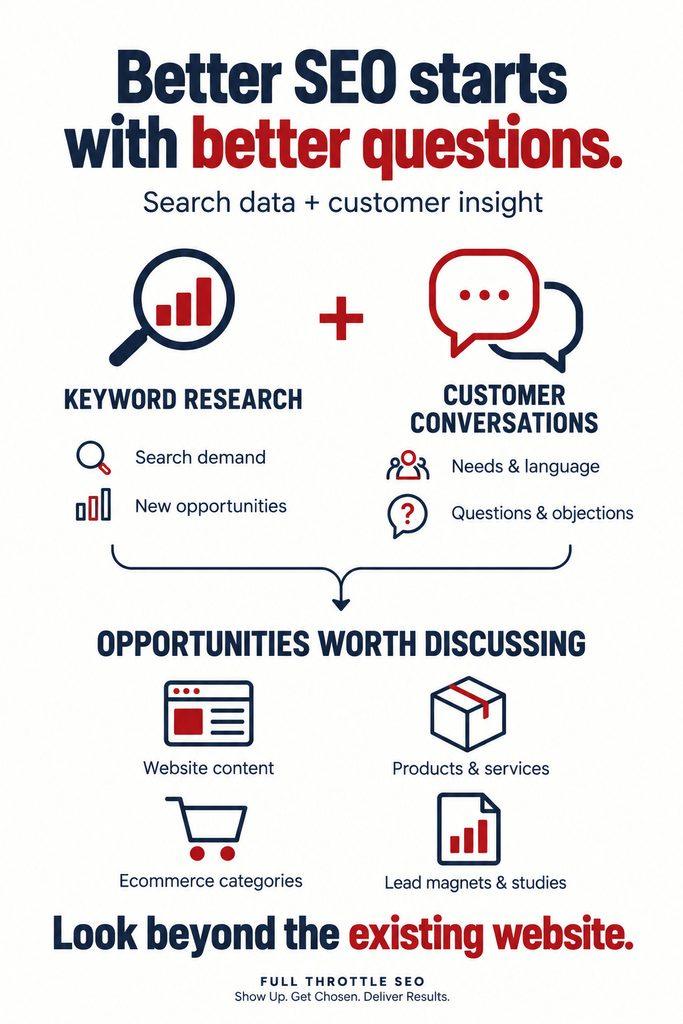
Keyword research can uncover opportunities for new products, services, or ecommerce categories, too. Customer conversations add context that helps us evaluate those opportunities and understand what would make them useful to the people we want to reach.
That’s part of the value I bring as a collaborative SEO partner. I look beyond the pages already on a client’s website for opportunities worth discussing. That might mean an ecommerce category that matches how customers shop, a lead magnet that addresses a recurring question, or an original study that helps buyers make a decision.
When I find an opportunity, I bring it into the conversation so we can assess it against the client’s goals, customer needs, and resources. SEO research becomes more valuable when it helps inform what the business could offer next, alongside improving what already exists.
Where to Find Customer Insights for Website Content
Start with information your business already has. You may not need a new research platform to identify useful patterns.
Sales and discovery calls can reveal purchase triggers, comparison criteria, objections, and questions about fit. Support conversations can show where product descriptions or instructions leave people confused. Customer emails can capture details that broad surveys miss.
Include prospects who didn’t buy. Their concerns may expose a missing explanation, or they may help you recognize an audience your business should not prioritize.
Ask colleagues for specific examples rather than broad impressions:
- What do prospects ask before they agree to a next step?
- What do customers seem surprised to learn?
- What do you repeatedly have to explain?
- What makes an inquiry a poor fit?
- What words do buyers use to describe the result they want?
If you use sales call transcripts for content research, follow your company’s recording and data-handling policies. Remove identifying or confidential details from working examples and get permission before publishing an attributable customer quote.
The useful information is the pattern and its context. You rarely need to publish the conversation itself.
How to Turn Customer Conversations Into SEO Content
Collecting questions is the beginning. The strategic work is deciding what those questions mean for your website.
1. Capture the Language and the Situation
Record the customer’s wording alongside their role, the problem they were trying to solve, and where they were in the decision process.
For example, “Will this work with our existing system?” could point to a missing compatibility detail, uncertainty about implementation, or a concern about replacing equipment. Those are different content needs.
A simple shared document can capture the question, context, recurring theme, and relevant website page. Keep the original wording separate from your interpretation.
2. Look for Patterns Among the Right Customers
Repeated questions deserve attention, especially when they come from people your business is equipped to serve.
Frequency is not the only consideration. One question from a qualified prospect can expose an important omission on a high-value service page. Meanwhile, a frequent request from people outside your target market may call for clearer qualification language.
Treat customer feedback as evidence to investigate. A handful of conversations cannot represent every buyer.
3. Combine Customer Language With Search Research
Use customer phrases as starting points for voice of customer keyword research. Investigate related queries, review the search results, and check whether the intent matches your audience and offering.
Do not assume the words used on a sales call are the exact words someone types into Google. A person explaining a problem to a specialist may speak differently from someone searching alone.
If a question shows little reported search volume, consider its role in the buying decision. It may still deserve an answer on a product or service page that already attracts relevant visitors.
4. Choose the Right Content Change
Turning customer questions into content doesn’t always mean writing another article.
The best response may be a clearer service description, a product specification, an explanation of implementation, or a short answer beside a contact form.
These hypothetical examples show how the decision can work:
| Customer question or concern | Possible website improvement |
|---|---|
| “Will this fit my vehicle?” | Add verified fitment information to relevant product or category pages. |
| “How much work will our team have to do?” | Explain client responsibilities on the service page. |
| “We need help with this specific situation. Do you handle it?” | Clarify who the service is for and any important exclusions. |
| “I don’t understand the difference between these options.” | Improve the existing comparison or create one if the question warrants it. |
Before adding a page, review what already exists. A content gap can be an unanswered decision question within an otherwise useful page.
5. Prioritize and Measure the Business Impact
Give priority to gaps that affect valuable products or services, recur among qualified buyers, and can be answered accurately.
Then choose measures that fit the change. A clearer qualification section may improve inquiry quality. Better product information may reduce pre-purchase questions. A new article may attract relevant search visits and help readers discover a service.
Where practical, compare performance before and after the update and ask sales or support colleagues what they notice. Consider other changes that could affect results before assigning credit to the content.
Where AI Can Help With Customer Research
AI tools can help organize approved, anonymized notes, group similar questions, and suggest themes for human review.
Keep those suggestions connected to the source material. Check whether a theme actually appears across conversations, whether an extracted phrase is accurate, and whether a summary has lost important context.
For AI search visibility, focus on clear, accurate explanations supported by your company’s expertise. Customer insights can help you decide which explanations matter, but using customer language does not guarantee rankings or citations.
Google’s guidance on helpful, people-first content encourages original information, useful analysis, and content that helps the intended audience achieve its goal. Customer research can inform that work; your team still needs to provide reliable answers.
Bring Customer Understanding Into Your SEO Strategy
My local SEO course and Google Business Profile Bootcamp taught me to pay closer attention to what people reveal in conversation.
For an in-house marketing manager, the opportunity is to bring that understanding into the research and reporting you already use.
That connects with Full Throttle SEO’s Show Up. Get Chosen. Deliver Results. framework: investigate how customers search, answer what matters to their decision, and measure whether the experience supports qualified leads or sales.
Start by asking your sales or customer service team for three questions they keep answering. Compare those questions with the pages a prospective customer would encounter. Identify the most consequential missing answer and improve it.
If your team needs help connecting customer insights, search opportunities, and website priorities, explore SEO consulting with Full Throttle SEO. We work alongside marketing teams to bring deeper SEO expertise into those decisions.

J. “Ivy” Boyter is the founder of Full Throttle SEO, a Florida-based SEO consultancy. With nearly 15 years of digital marketing experience, she helps businesses turn search visibility into qualified leads and revenue, with a focus on ecommerce SEO, technical audits, and visibility in AI-powered search. Her approach connects SEO priorities to business goals, helping brands show up, get chosen, and deliver results.
Outside of work, Ivy competes in autocross and rallycross, wrangles kids and chickens, and writes heartfelt marriage and parenting advice.